Home › Hard Sudoku
Hard Sudoku — the ten levels up to Titan
What makes a Sudoku genuinely hard is the technique it demands — an X-Wing, a Swordfish, a chain. At some point no cell falls to simple counting any more, and that is where the real game starts. The number of givens has little to do with it.
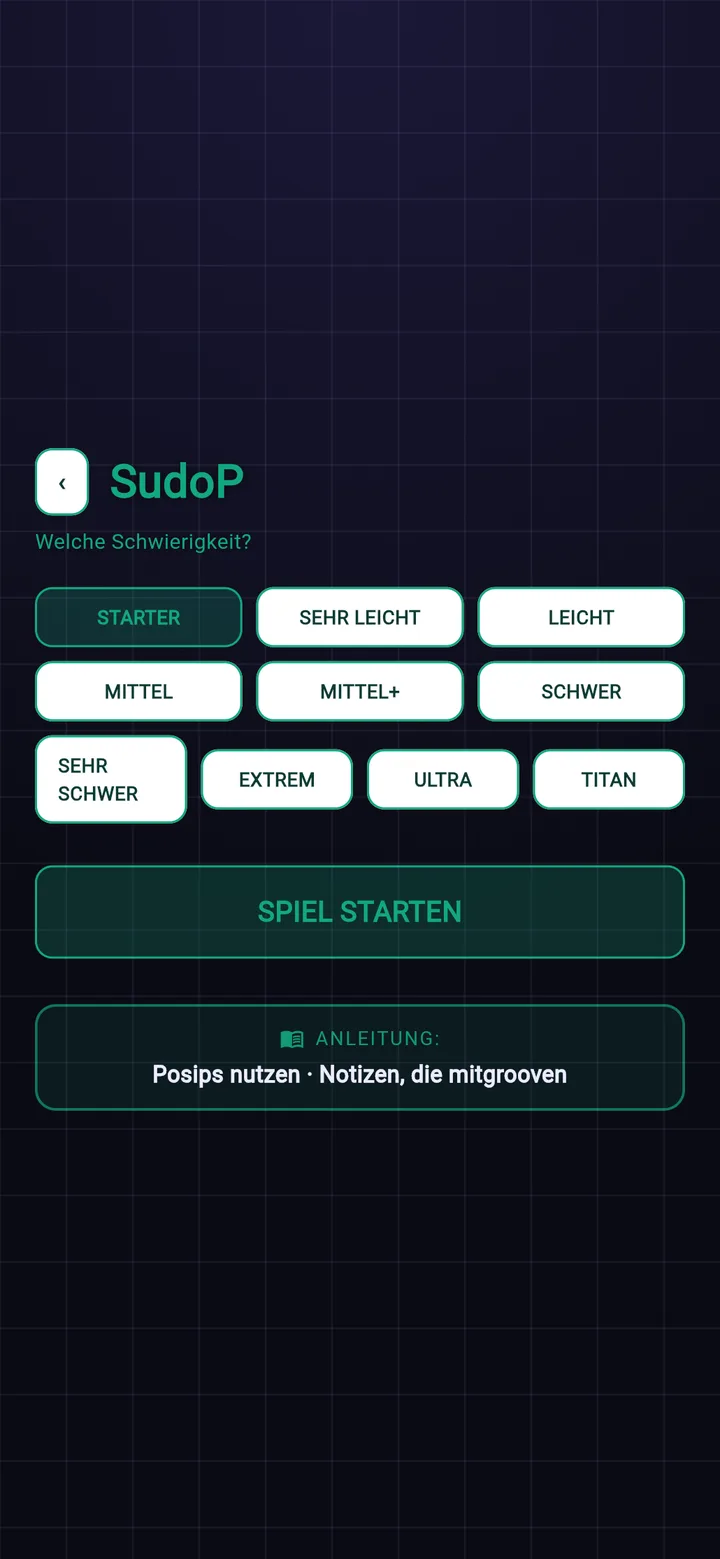
SudoSuite has ten difficulties from Starter to Titan. Every one of them is solvable without guessing, has exactly one solution and passes five checks before it is delivered. What the individual levels ask for is in the table below.
- Ten levels
- Guessing never needed
- Exactly one solution
- Chain guaranteed in Titan
- Plays offline
The ten difficulties and what they ask for
The middle column describes what kind of technique usually becomes necessary at that level. A single puzzle may turn out easier, and more than one route to the answer is common. The names come from the usual Sudoku vocabulary; all of them are explained in SudoLearn.
| Level | What is usually needed | Who it is for |
|---|---|---|
| Starter | Singles — the obviously free cell | Getting started, no experience needed |
| Very easy | Singles, nothing more | On the side, to warm up |
| Easy | Singles, just a little more searching | The classic newspaper Sudoku |
| Medium | Singles that are easy to miss without notes | Anyone who plays regularly |
| Medium+ | many singles in a row, deeply nested | The first puzzles that get sticky without notes |
| Hard | several steps in a row, still without a named technique | Experienced players who keep tidy notes |
| Very hard | from here usually one named technique — most often Locked Candidates | The start of the technique game |
| Extreme | exactly one real technique step — an X-Wing, a Naked Pair, a Skyscraper | Players who spot the basic patterns reliably |
| Ultra | 2 to 12 technique steps, plus expert patterns such as Sue de Coq | Advanced players with a broad repertoire |
| Titan | at least one real chain — guaranteed | The toughest level in the app |
“Usually needed” means: this kind of technique is intended for the level. Which technique applies in a particular puzzle depends on the puzzle — and several valid routes are the norm, not the exception.
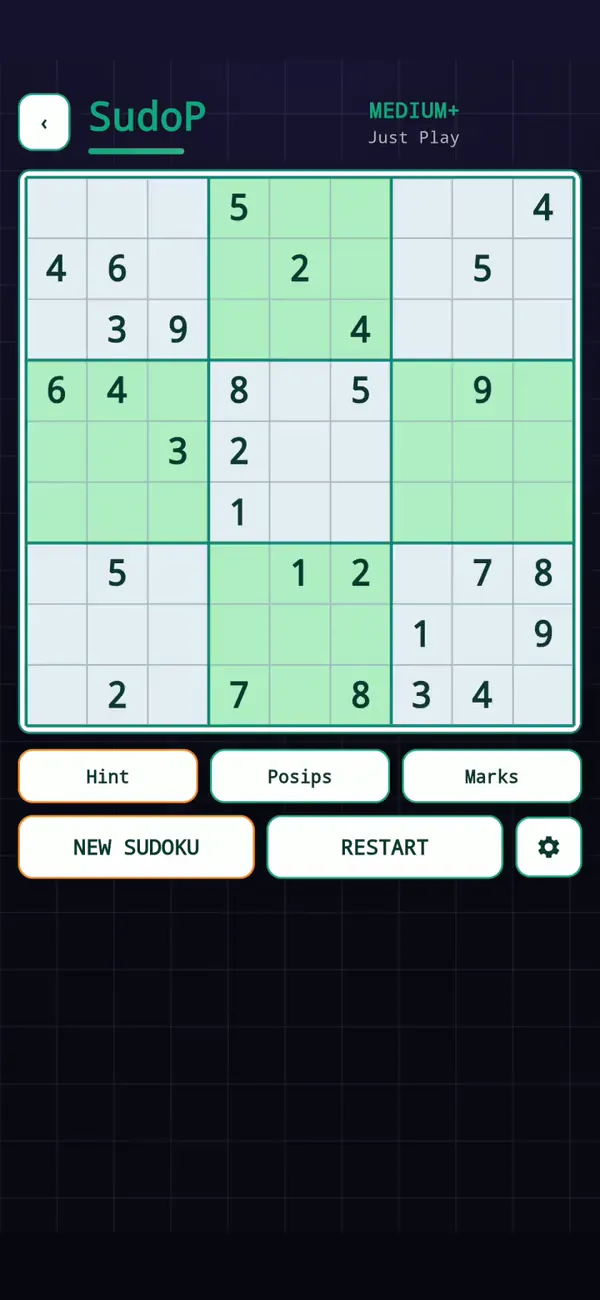
Try a hard puzzle right here — and see whether you get through it without a hint.
NowPlay Sudoku onlineno sign-up, no waitingWhy “guaranteed” is meant literally here
In many apps the difficulty is an estimate based on the number of givens. SudoSuite checks the solving path itself instead: a Titan that can also be solved without a chain is never delivered. On average eight puzzles are generated before one passes all the checks.
That has one nice consequence. If a chain is needed on Titan, then a chain really is in there. You are not hunting for something that may not exist.
No guessing, exactly one solution
A hard Sudoku may be demanding, but it must not be unfair. So the same applies to every level:
- Exactly one solution. No puzzle with two valid outcomes.
- Solvable without guessing. There is always a logical next step; trial and error is never necessary.
- Five checks are run on every puzzle before it enters the game.
- The solving path is known. That is why a hint names not just the number but the technique that applies here.
Hard does not automatically mean under time pressure
The same ten levels exist in both modes. In SudoP no clock runs — a Titan may take you two evenings. In SudoG you are timed and scored, with points and medals. The Marks system helps in both cases: coloured markers and chain nodes right in the grid, so you do not have to hold a long chain in your head. That is where most people fail at Ultra and Titan — not on understanding, but on bookkeeping.
A hard puzzle with one specific technique
If you want to practise a particular hard technique, you order the puzzle to match instead of working through dozens until it turns up by chance. With SudoSelect you set out what should be in it: require techniques or exclude them, at random or guaranteed, plus the length of the solving path and a pre-solve of the trivial opening moves. That way you ask for a puzzle that definitely contains a Swordfish — and nothing else to distract you. SudoSelect is part of Pro.
How learning, practising and ordering work together is on Rediscover Sudoku.
Hard Sudoku on paper
The tough levels exist in print too: SudoCreator puts together your own booklets as PDF, 2 to 88 puzzles per sheet, with a QR code next to every puzzle. If you get stuck on paper, you scan the QR and SudoSolver names the next logical step with its reason. Ready-made sheets are here to download.
Try the hard levels
Titan is waiting — and every single one holds a guaranteed chain. All ten difficulties are free to play, Ultra and Titan included. Ordering puzzles by technique comes with Pro, a single $5.49 and no subscription.
Common questions
What is the hardest Sudoku in SudoSuite?
Titan. Every Titan puzzle is guaranteed to contain at least one real chain; one without a chain is never delivered. Below it are Ultra and Extreme, which ask for named techniques but not necessarily a chain.
From which level do I need X-Wing and Swordfish?
From Extreme. Before that, on Very hard, Locked Candidates is usually the first named technique; the X-Wing and the Swordfish arrive one level later. On Ultra several technique steps come together, up to expert patterns such as Sue de Coq. In a particular puzzle it depends on the puzzle, and more than one route often leads to the answer.
Do I have to guess in hard Sudoku at some point?
No. Every puzzle is solvable without guessing and has exactly one solution. There is always a logical next step — you just will not find it without the right technique.
Can I get a Sudoku with one specific technique?
Yes, with SudoSelect. You require techniques or exclude them, at random or guaranteed, plus the length of the solving path and the pre-solve. SudoSelect is part of Pro.
Are the hard levels free to play?
Yes, all ten from Starter to Titan. There is no level you have to buy. What else you get without paying is on the page Free.
Why does “hard” feel different in other apps?
Because difficulty is measured in different ways. Often only the number of givens is counted. SudoSuite rates the solving path instead and delivers only puzzles that really meet the requirements of their level.