Home › Hidden Triple and Quad
Hidden Triple and Hidden Quad in Sudoku explained
When a unit has become unreadable under all those pencil marks, this is the technique that tidies it up. In a Hidden Triple, three digits occur within one unit only inside the same three cells — in a Hidden Quad, four digits inside four cells. Those places are therefore reserved for those digits, and every other candidate in the cells can be eliminated.
It is the same logic as the Hidden Pair, just one digit and one cell wider: three digits on three places, four on four. You find both the same way — not by looking, but by counting. The counterpart is the Naked Triple and Quad.
- Basic technique
- Needed from Extreme
- Needs pencil marks
- Eliminates candidates
- Hidden Quad is rare
How to spot one
- 1. Take one unit. You search in a row, a column or a box — and that is the only place you eliminate.
- 2. Note the places for each digit. Walk through the missing digits one at a time and write down where each one is still possible. Digits with two or three places are good starting points.
- 3. Put three digits together. Combine their lists of places. If they occupy exactly three cells, you have a Hidden Triple. For the quad you take four digits and arrive at four cells.
- 4. Clear up inside the cells. Eliminate every other candidate there. What remains are the digits of the group — a visible Naked Triple.
- 5. Run the reverse check. None of the digits involved may have a place outside those cells. Counting the target cells alone is not enough.
Why it works
Every digit needs exactly one place in its unit, and two digits cannot occupy the same one. Three digits with only three cells fill those cells completely: each cell gets one of the three. There is no room left for a fourth candidate, however plausible it looks. The same holds for the quad, with four digits and four cells. The digits do not have to occur in every cell of the group — all that matters is that none of them is still possible outside it.
A worked example
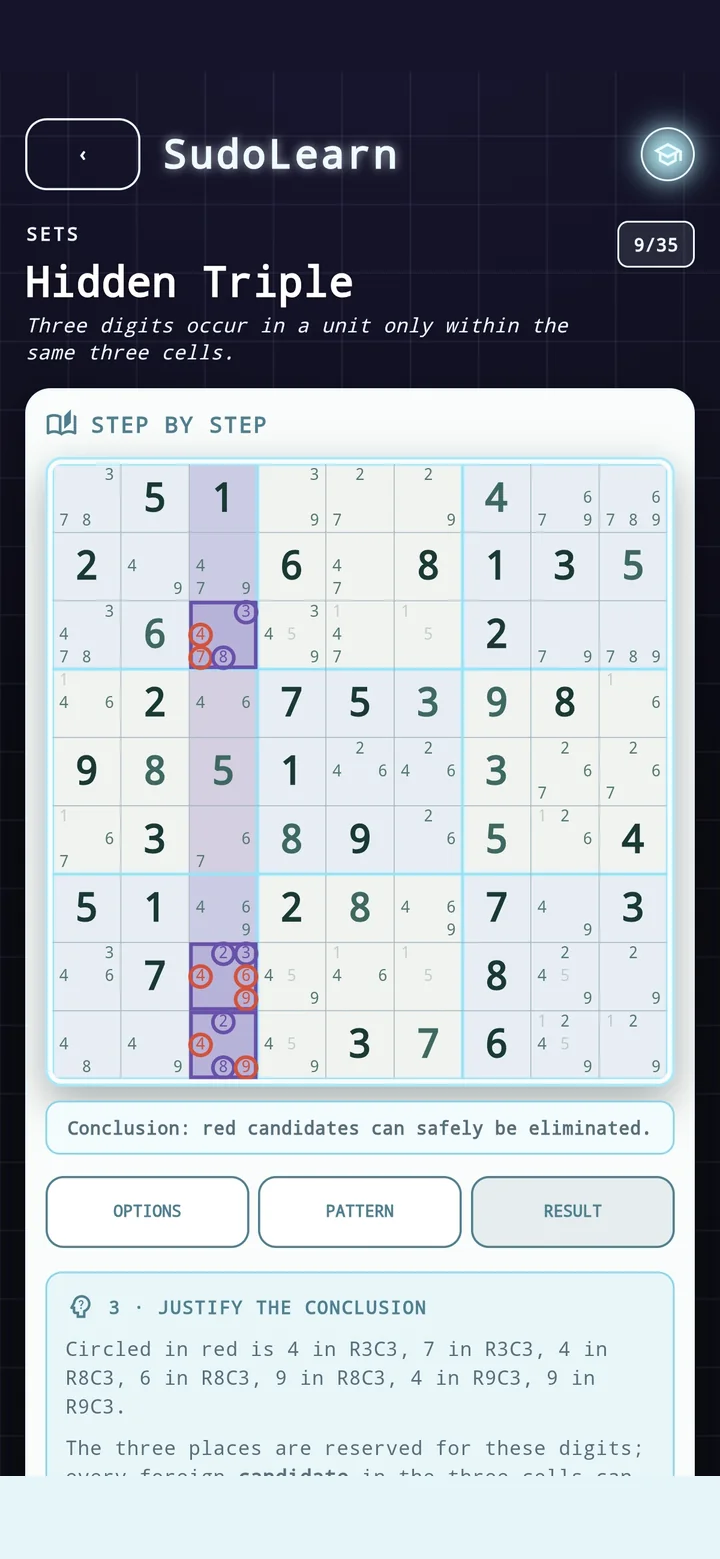
The triple first, in column 6. There the digits 1, 4 and 7 are only possible in row 2, row 5 and row 9: the 1 in rows 2 and 9, the 4 in rows 2 and 5, the 7 in rows 5 and 9 — three cells for three digits.
The pencil marks looked harmless: row 2 carried {1,4,6,8}, row 5 carried {4,6,7} and row 9 carried {1,7,8}. Because those three cells are reserved for 1, 4 and 7, the 6 and the 8 drop out there. What remains is {1,4}, {4,7} and {1,7} — a Naked Triple.
The quad runs the same way, one size bigger. In the bottom right box the digits 2, 3, 5 and 8 are only possible in four cells: row 7, column 7, row 7, column 9, row 9, column 7 and row 9, column 8. Every other candidate there — here 1, 6 and 9 — is eliminated. That none of the four digits fits anywhere outside the group is something you have to have checked one digit at a time; with a quad, that is the real work.
Where it shows up in SudoSuite
From Extreme upwards, bigger subsets lie on the solving path. Hidden Triples are the least conspicuous variant there; Hidden Quads stay rare and turn up almost only in candidate-rich units, usually alongside patterns such as the X-Wing. The full list of levels is on hard Sudoku.
- SudoLearn has its own chapters for the Hidden Triple and the Hidden Quad. They build on the Hidden Pair, so on something you already have — with an example grid and an exercise right inside the lesson.
- SudoTrainer tests both sizes and checks your reasoning, not just the answer. Another valid route counts just as much — and with counting that is worth its weight in gold: you notice at once where you miscounted.
- SudoSolver does not just tell you what drops out at the next step — it tells you why. You learn something from that; from a bare digit you do not.
Common mistakes
- Hidden is not Naked. In a Hidden Triple three digits have only three possible cells; in a Naked Triple three cells together hold only three candidates — there you eliminate in the rest of the unit, here inside the cells themselves. This is by far the most common mix-up.
- Overlooking the fifth place. If, in a quad, one of the four digits still has a fifth possible cell, the pattern is invalid.
- Hunting for cell lists. Anyone looking for cells that look alike finds nothing but Naked Subsets. You find Hidden Subsets through the question “where is this digit still allowed to go?” — the same question as with the Hidden Single.
Hidden Triple — the pattern nobody finds unaided
Three digits sharing three cells, buried under a pile of other candidates. Without clean pencil marks it is invisible; with them it is findable.
- Marks first, pattern second. The Marks & colours chapter is compulsory here, which is why SudoLearn puts it ahead of the pattern techniques.
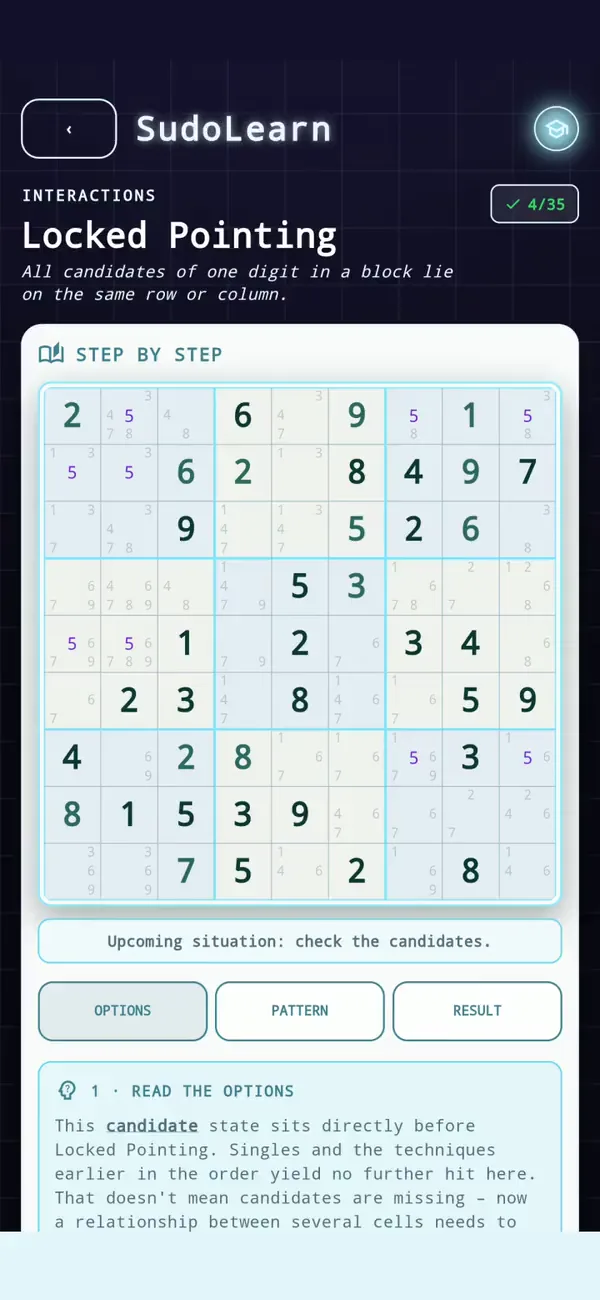
- Step by step on the grid. The lesson fades out the distracting candidates one by one until only the triple is left. After that you see it unaided.
- Supply to order. With SudoSelect Hidden Triples are guaranteed in your next puzzle, as often as you like.
Learn to see hidden groups
SudoLearn walks you through threes and fours step by step, SudoTrainer tests them — no account, offline, as often as you want.
Common questions
What is a Hidden Triple in Sudoku?
Three digits that are possible, within one row, column or box, only inside the same three cells. In those three cells every other candidate can be eliminated.
What is a Hidden Quad?
The same pattern with one digit and one cell more: four digits that together have only four possible cells. Every other candidate there drops out.
What is the difference between a Hidden Triple and a Naked Triple?
In a Naked Triple three cells together hold only three candidates, and you eliminate in the rest of the unit. In a Hidden Triple three digits have only three possible cells, and you eliminate inside those three cells.
Do all three digits have to sit in each of the three cells?
No. It is enough that none of the three digits has a place outside those cells.
Why are Hidden Quads so rare?
Because four digits have to be confined to four cells at the same time. That happens almost only in units with many open cells, where the other side of the pattern is often easier to find.