Home › Hidden Single
Hidden Single in Sudoku — how to find it
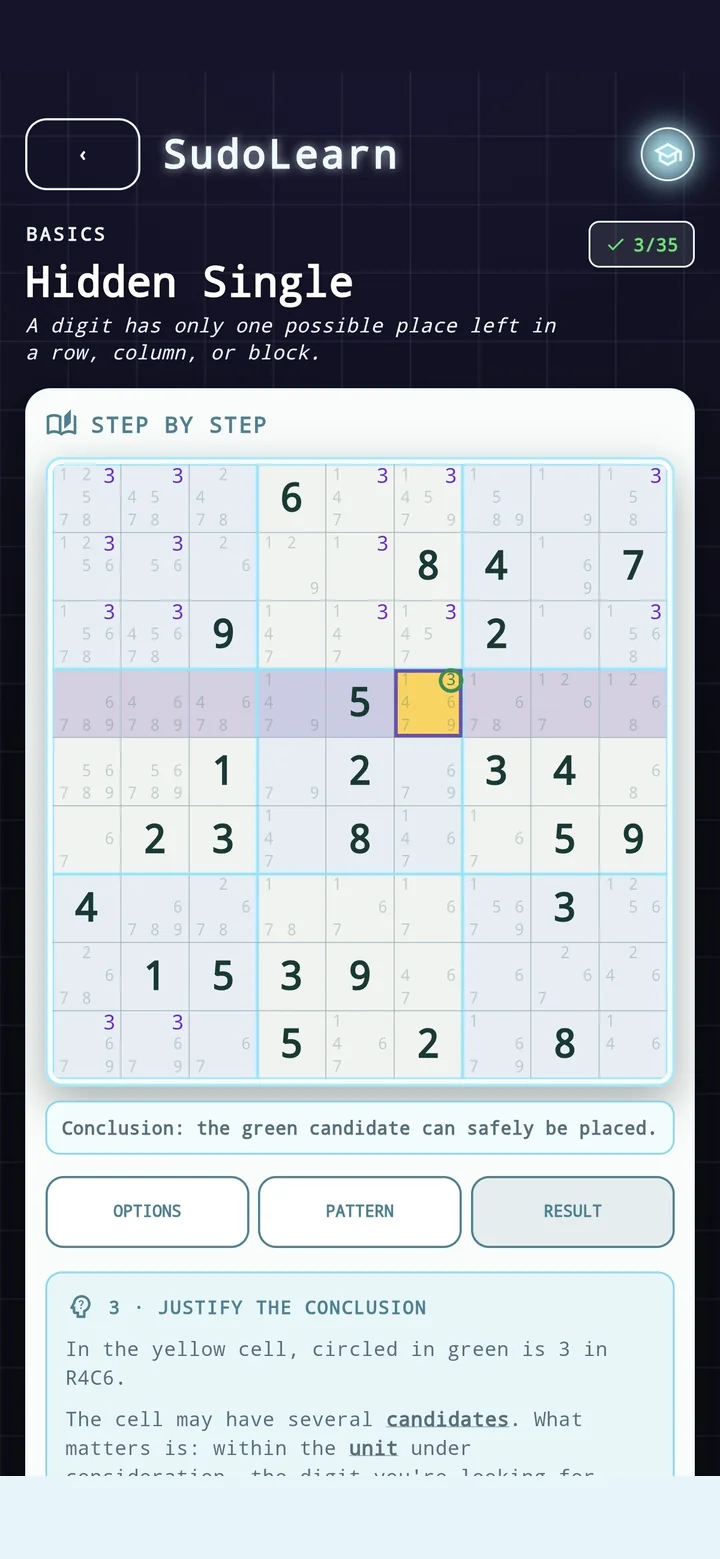
This is the technique that turns hard staring into smooth solving — and you can have it in five minutes. A Hidden Single is a digit that has only one place left in a row, a column or a box. That place gets the digit — even if other candidates are still pencilled into the cell.
No basic technique gives you more. The Hidden Single finds placements the Naked Single cannot see, because it asks the digit rather than the cell. Switch your eye once from cell by cell to digit by digit, and easy and medium puzzles run noticeably faster.
- Basic technique
- Needed from Starter
- Works without pencil marks
- Places a digit
- Also “unique candidate”
How to spot one
- 1. Pick a unit. Take one row, one column or one box. Boxes are easier to start with, because you have three rows and three columns in view at once.
- 2. Pick a missing digit. Which digit is still missing from that unit? Take one of them — and only that one.
- 3. Check every place. Which empty cells of the unit could hold that digit? A cell drops out as soon as the digit already appears in its row, its column or its box.
- 4. One place left means place it. You have found the cell — no matter which other candidates are still sitting in it.
Why it works
In every row, every column and every box each digit appears exactly once. So the digit has to land somewhere inside the unit you are looking at. Once you have ruled out every place but one, there is nowhere else for it to go: the last remaining place must take the digit. The fact that other candidates are pencilled into that cell changes nothing — they lose their claim after the fact and get struck out.
A worked example
Look at the top left box (rows 1 to 3, columns 1 to 3). The 4 is still missing there, and only three cells are free: row 1 column 2, row 3 column 1 and row 3 column 3.
- Row 1 already holds a 4 further right, outside the box — so row 1, column 2 drops out.
- Column 3 already holds a 4 further down — so row 3, column 3 drops out.
That leaves row 3, column 1. The 4 goes there, even if that cell still carries 4, 7 and 8 as candidates. The 7 and the 8 are struck out. This is exactly what cell-by-cell scanning misses: a cell with three candidates looks undecided — from the point of view of the digit 4, it is not.
Where it shows up in SudoSuite
Hidden Singles appear at every difficulty, from Starter to Titan. In the levels up to Hard they carry the whole solving path together with the Naked Singles; in the hard levels they are what gets the grid moving again after each technique step. Which level asks for what is on hard Sudoku.
- SudoLearn has its own chapter on it — and you do not just read it, you place the Hidden Single yourself, right inside the lesson, in the example grid, with feedback.
- SudoTrainer never names the technique: you get the position and have to recognise it. It checks your reasoning, and another valid route counts just as much. That is how knowing turns into being able to.
- SudoSelect (Pro) hands you a puzzle with this technique guaranteed inside.
- SudoSolver helps differently from a hint button when you are stuck: it does not tell you the digit, it shows you the step with the reason behind it.
Common mistakes
- Mixing it up with the Naked Single. The classic error: “this cell still has three candidates, so I cannot place anything.” With a Hidden Single, other candidates in the target cell are expressly allowed.
- Searching cell by cell instead of digit by digit. Working through the grid cell by cell hardly ever turns up a Hidden Single. Take one digit and walk it through the units.
- Only scanning boxes. Boxes are convenient, but rows and columns give you just as many Hidden Singles. Skip them and you get stuck sooner.
- Leaving the other candidates in place. After placing the digit, the cell's remaining candidates have to go — otherwise you carry false pencil marks around.
Hidden Single — the technique you already use
Almost every player finds Hidden Singles without knowing the name. That is exactly why the chapter pays off: with a name you find them systematically instead of by luck.
- The lesson on a real grid. SudoLearn walks through row, column and box and shows the unit where the digit has only one seat left.
- Checked by the quiz. The quiz questions between lessons probe the difference from a Naked Single. Plenty of players mix the two up — after this, you won't.
- Look it up mid-game. Tap a technique name while playing and you land in its lesson, then come straight back to your puzzle.
Learn to scan digit by digit
SudoLearn explains the Hidden Single step by step, SudoTrainer tests it — and after a few rounds you stop searching and start seeing.
Common questions
What is a Hidden Single in Sudoku?
A digit that has only one possible place left in a row, a column or a box. That place gets the digit.
Why is it called a Hidden Single?
Because the candidate that decides it is hidden among the other candidates of the same cell. You only see it once you look at the unit from the digit's point of view.
May the cell still hold other candidates?
Yes, and that is exactly what separates the Hidden Single from the Naked Single. The other candidates are struck out once the digit is placed.
Do I need pencil marks for Hidden Singles?
No. Hidden Singles in a box are easy to find by scanning, with no pencil marks at all. In rows and columns, though, pencil marks help a lot.
What comes after the singles?
When Naked and Hidden Singles stop working, Locked Candidates is usually next: Pointing and Claiming. In SudoSuite it is needed from Very hard on.