Home › Naked Triple and Quad
Naked Triple and Naked Quad in Sudoku explained
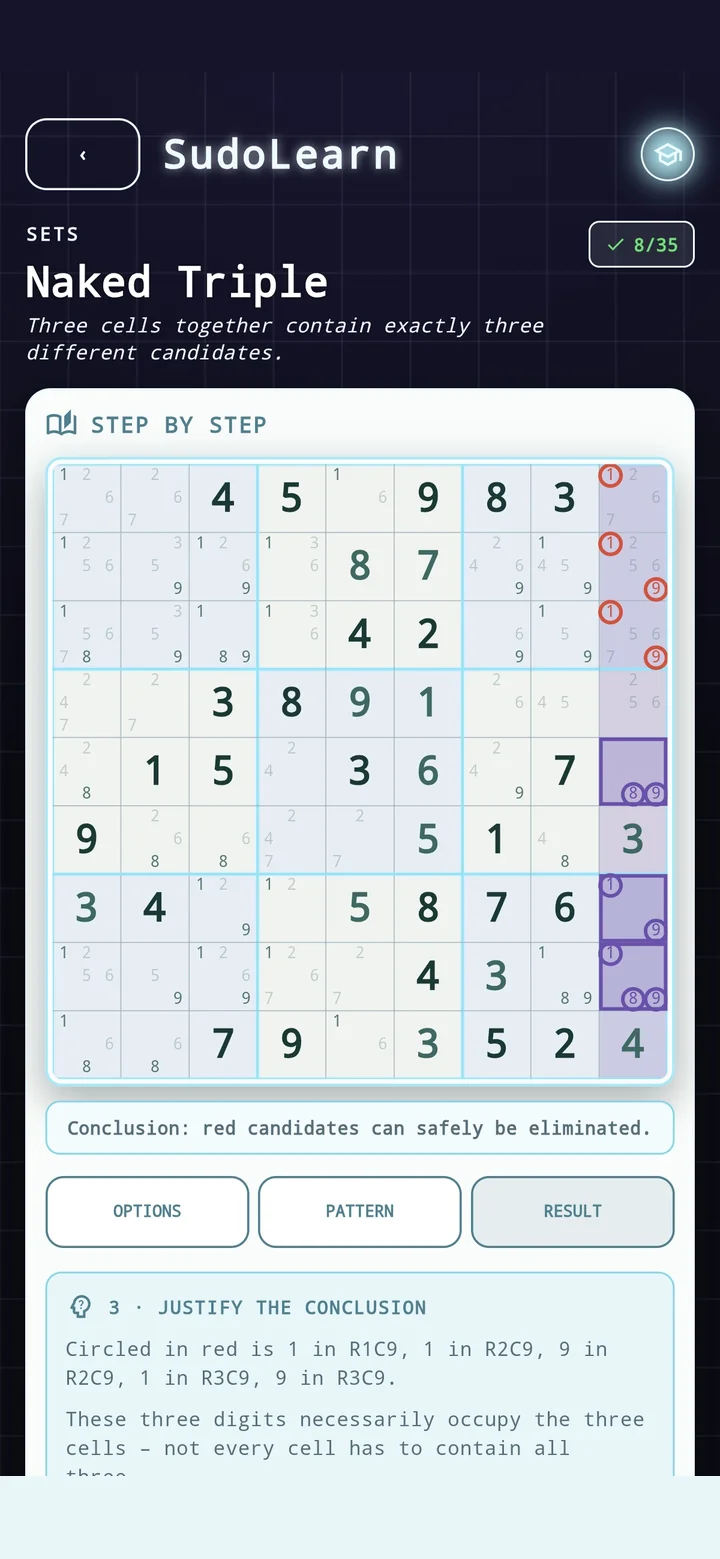
When the pair is not enough any more, the group of three takes over — and it clears thoroughly. A Naked Triple is three cells of one unit that together hold exactly three different candidates; a Naked Quad is four cells with exactly four candidates. Those digits have to be shared out among the cells of the group, so they disappear from every other cell of the unit.
It is the same logic as the Naked Pair, just one cell wider: two cells for two digits, three for three, four for four. Only the searching is different, because unlike the pair, not every cell has to carry every digit. The counterpart is the Hidden Triple and Quad.
- Basic technique
- Needed from Extreme
- Needs pencil marks
- Eliminates candidates
- Also “triplet” and “quadruple”
How to spot one
- 1. Take one unit. You search in a row, a column or a box — and that is the only place you eliminate.
- 2. Pick the lean cells. For a triple only cells with two or three candidates qualify; for a quad, cells with two to four.
- 3. Build the union. Take three of those cells and write down all their candidates together, each digit once. If there are exactly three, you have a Naked Triple. For the quad you take four cells and count up to four digits.
- 4. Eliminate. Remove those digits from every other cell of the unit. The group itself stays untouched.
- 5. Start from a pair. A pair you have found is often part of a triple, and a triple is often part of a quad.
Why it works
Three cells need three different digits, because no digit may appear twice in a unit. If only three digits are available for them, the distribution is settled: each digit lands in exactly one of the three cells. Which one goes where stays open. All three are used up inside the group and are no longer available to any other cell of the unit. The same holds for the quad, with four cells and four digits.
A worked example
The triple first, in row 7. The cell in row 7, column 2 holds {4,8}, row 7, column 5 holds {4,9} and row 7, column 9 holds {8,9}. Together that is the three digits 4, 8 and 9 in three cells. No single cell contains all three, and that is exactly the point: you recognise a triple by the union, not by the look of the individual cell. The 4, the 8 and the 9 drop out of every other cell of row 7.
Now the quad, in column 3. There row 1 holds the candidates {1,5}, row 4 holds {1,7}, row 6 holds {5,9} and row 8 holds {7,9} — four cells, together the four digits 1, 5, 7 and 9. They are eliminated from every other cell of column 3. If only one cell besides the quad is still empty, it immediately gets the last missing digit — a Naked Single as a consequence.
The short cut: which side you count from
A Naked Quad in a unit with six empty cells says exactly the same thing as a Hidden Pair in those same six cells: four digits are tied up, so the two remaining cells are left with precisely the other two. So count quickly how many cells are still open — if the unit is nearly full, you are better off looking for the smaller group.
Where it shows up in SudoSuite
From Extreme upwards, bigger subsets lie on the solving path, sometimes several times in one puzzle. In Ultra and Titan they appear alongside named patterns such as the X-Wing. The full list of levels is on hard Sudoku.
- SudoLearn has its own chapters for the Naked Triple and the Naked Quad — with an example grid and an exercise right inside the lesson. Both build on the pair, so you are not starting from scratch.
- SudoTrainer tests both sizes and checks your reasoning, not just the answer. Another valid route counts just as much.
- Marks save you the mental juggling: colour the cells of the group before you eliminate anything in the rest of the unit, and you will not miss one.
Common mistakes
- Naked is not Hidden. In a Naked Triple three cells together hold only three candidates; in a Hidden Triple three digits have only three possible cells — there you clear inside the cells, here in the rest of the unit. This is by far the most common mix-up.
- Expecting three matching three-candidate cells. {4,8,9} three times is a triple, but it is the exception. Most of the time it looks like {4,8}, {4,9}, {8,9}.
- One digit too many. If the union comes to four digits, it is not a triple, it is nothing at all. For the quad the same applies at five.
- Taking a crowded cell along. A cell with four candidates cannot belong to a triple, even if three of them fit.
Triples and quads — when not every cell holds everything
The most common mistake is assuming all three cells must carry all three digits. They don't — and that assumption is exactly why people miss them.
- The lesson clears that up. SudoLearn shows the textbook case first, then the three shapes that actually turn up in real puzzles.
- The SudoTrainer checks your reasoning. It asks which three cells form the triple, not merely which candidate drops.
- Play it to order. SudoSelect puts Naked Triples into your next puzzle for certain, with the length of the solving path on top if you want it short.
Practise triples and quads
SudoLearn explains both sizes, SudoTrainer tests them — no account, offline, until the group stands out in the grid by itself.
Common questions
What is a Naked Triple in Sudoku?
Three cells of one row, column or box that together hold exactly three different candidates. Those three digits can be eliminated from every other cell of the unit.
Does every cell have to hold all three candidates?
No. All that counts is the union of all three cells. The typical shape is {1,2}, {1,3}, {2,3} — no cell there carries all three digits.
What is a Naked Quad?
The same pattern with one cell more: four cells of a unit that together hold exactly four candidates. Those four digits drop out of the rest of the unit.
What is the difference between a Naked Triple and a Hidden Triple?
In a Naked Triple three cells together hold only three candidates, and you eliminate in the rest of the unit. In a Hidden Triple three digits have only three possible cells, and you eliminate inside those three cells.