Home › Two-String Kite
Two-String Kite in Sudoku — spotting the kite
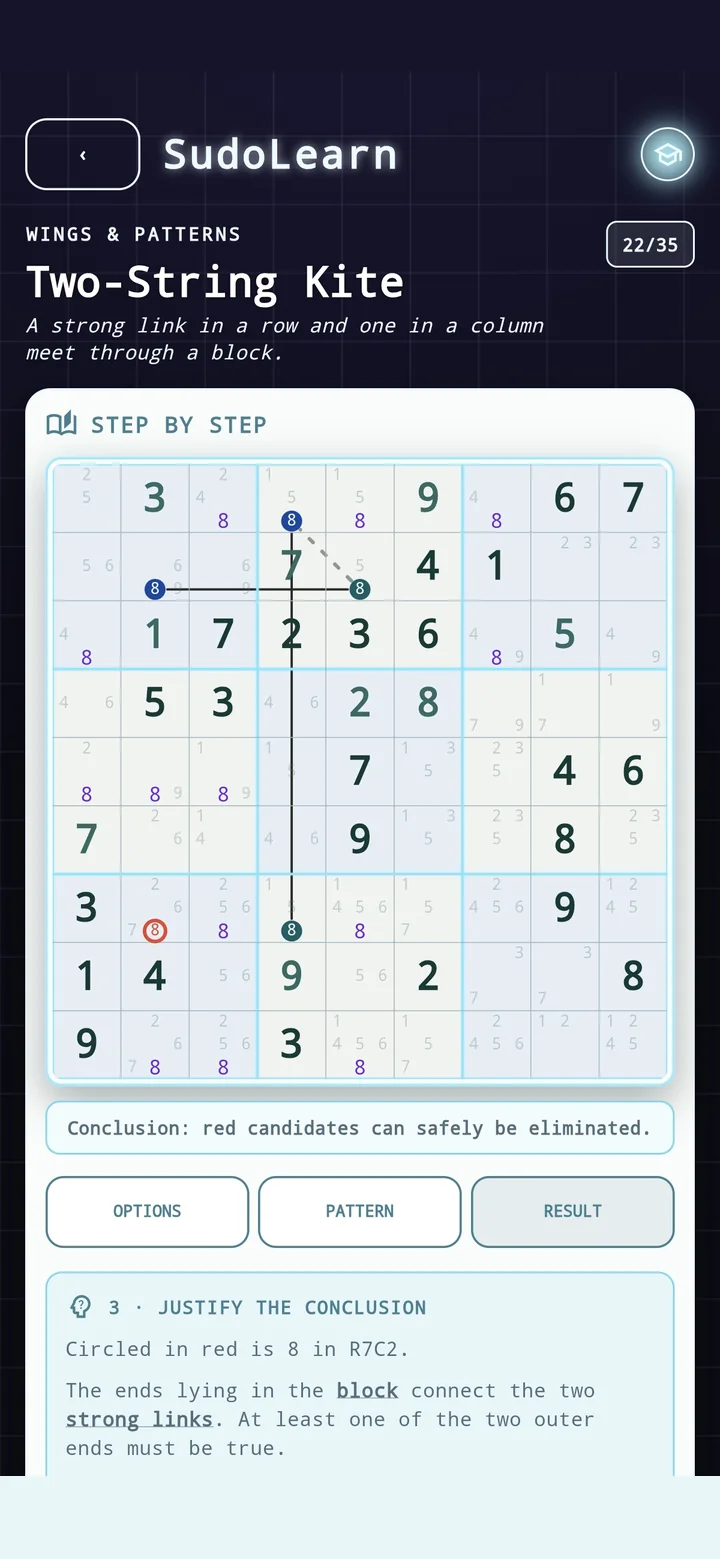
One row, one column, one shared box — and somewhere far away a candidate drops. In a Two-String Kite a digit has exactly two places in a row and exactly two places in a column, and one end of each pair sits in the same box. The cell that sees both outer ends can no longer carry the digit.
The name comes from the shape: two “strings” that run together inside the box, like a kite. It is the sibling of the Skyscraper — there both strong links are of the same kind, here a row and a column cross. It eliminates candidates rather than placing one, but once you know both patterns you will find one of the two in almost any hard puzzle.
- Advanced
- Needed from Extreme
- Needs pencil marks
- Eliminates candidates
- Family: single-digit patterns
How to spot one
- 1. Fix one digit. Single-digit patterns are hunted digit by digit.
- 2. Find a row with two places. That is the first string.
- 3. Find a matching column. Exactly two places as well — and placed so that one end of the row and one end of the column sit in the same box.
- 4. Sort inner from outer. The candidates in the shared box are the inner ends, the remaining two are the outer ends.
- 5. Eliminate. The digit falls in every cell that sees both outer ends — usually exactly one: the crossing of one end's row with the other end's column.
Why it works
Both strings are strong links: in the row the digit has to take one of the two places, and in the column likewise. The inner ends share a box — so they cannot both be true.
If the outer end of the row does not carry the digit, it sits at the inner end, which blocks the inner end of the column — and the outer end of the column carries it. At least one of the two outer ends is therefore true. Which one stays open: a cell that sees both of them loses the candidate either way.
A worked example
Take the digit 4. In row 2 it is only possible in column 1 and column 5; in column 6 only in row 3 and row 8. Row 2 column 5 and row 3 column 6 both lie in the top centre box (rows 1 to 3, columns 4 to 6) — those are the inner ends. Outside sit row 2 column 1 and row 8 column 6.
If row 2 column 1 holds no 4, then the 4 of row 2 sits in column 5. That uses it up in the centre box, so row 3 column 6 falls — and the 4 of column 6 has to go to row 8. At least one of the outer ends carries the 4.
Which cell sees both? Row 8 column 1 — in column 1 like one end, in row 8 like the other. The 4 is eliminated there. Often that is the kite's only elimination; it is usually enough.
Where it shows up in SudoSuite
From Very hard upwards a named technique is needed; the Two-String Kite turns up typically from Extreme. More on hard Sudoku.
- SudoLearn has its own chapter on the kite — and you do not just read it, you string it up in the example grid yourself, with feedback.
- SudoTrainer puts the pattern in front of you, on request without naming it. It checks your reasoning, not just the answer; another valid route counts just as much.
- SudoSelect (Pro) hands you a puzzle with a guaranteed Two-String Kite — as many as you need to practise.
- Marks make the kite visible: chain nodes on the strings, the inner ends in colour. Then it is obvious straight away which ends are the outer ones. In SudoP you can hunt for it with no clock at your back.
Common mistakes
- The inner ends share no box. Then there is no bridge.
- A third place on one of the lines. That destroys the strong link.
- Eliminating in the wrong cell. Not in the box and not at the ends, but where the lines of sight of the outer ends cross.
- Confusing it with the Skyscraper. There both links are of the same kind and the bridge is a line.
- Inner ends in the same cell. If row and column cross in one candidate, it is not a kite.
Two-String Kite — the same trick, stretched across a box
A row and a column instead of two rows, joined through a box. If you can do the Skyscraper, the kite takes another ten minutes.
- Packaged with the Skyscraper. SudoLearn puts the two in neighbouring chapters, because they are the same logic wearing a different shape.
- Exercises that mix them. The tasks shuffle both patterns so you learn to tell which one is actually in front of you — that is the real hurdle.
- Order it on purpose. With SudoSelect the Two-String Kite is guaranteed in your next puzzle, or ruled out while you practise something else.
Fly the kite yourself
With SudoSelect you order exactly the pattern you want to practise — and after a few rounds you see the strings on your own.
Common questions
What is a Two-String Kite in Sudoku?
A pattern in which a digit has exactly two places in a row and exactly two places in a column, with one end of each sitting in the same box. The cell that sees both outer ends loses the digit.
Where do you eliminate in a Two-String Kite?
In every cell that sees both outer ends — as a rule exactly one: the crossing of one end's row with the other end's column.
What is the difference from the Skyscraper?
The kind of strong links involved. In a Skyscraper they are two rows or two columns, joined through a line. In a Two-String Kite they are a row and a column, joined through a box.
Is the Two-String Kite part of the Turbot Fish family?
Yes, together with the Skyscraper and the Empty Rectangle. If none of the three shapes fits, the same conclusion is called a Turbot Fish.