Home › Skyscraper
Skyscraper in Sudoku — how to spot the pattern
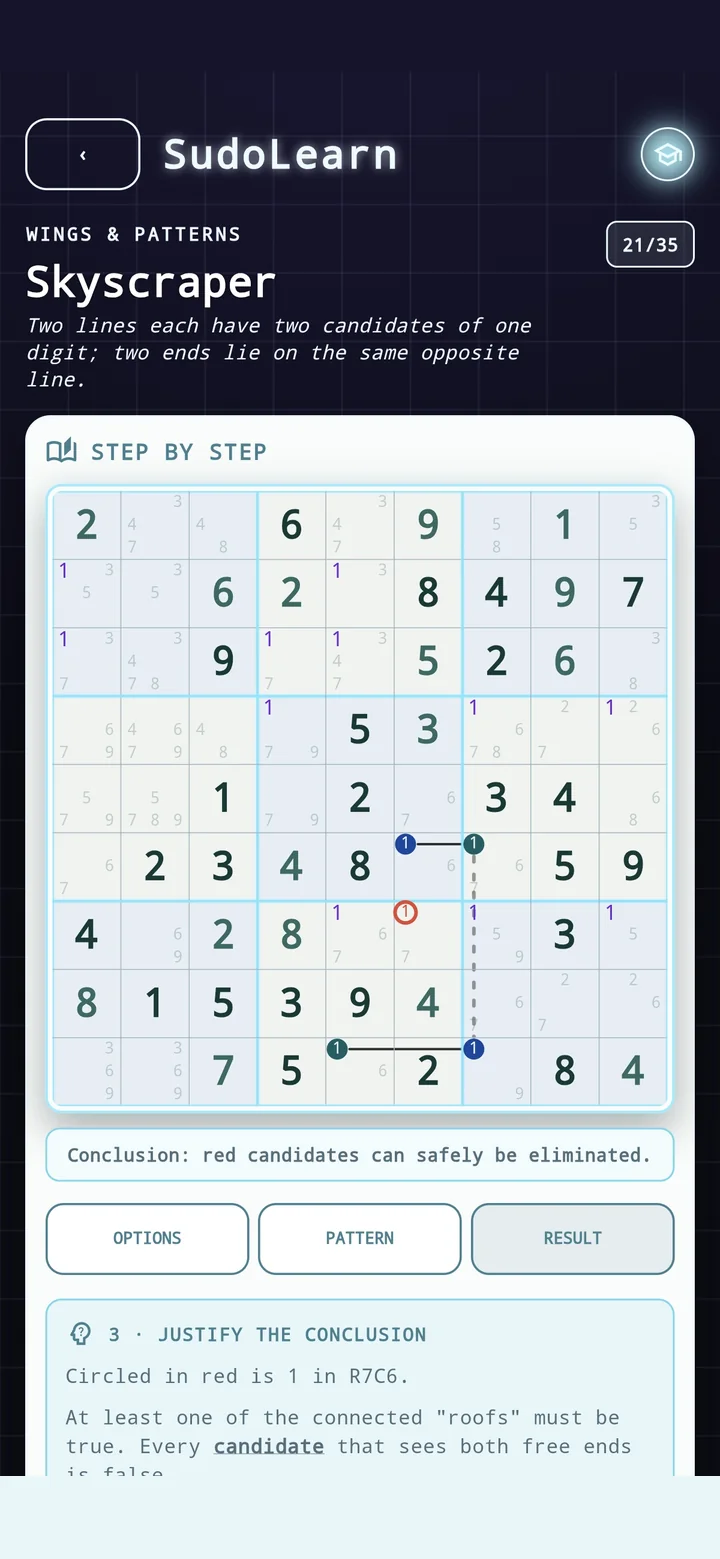
The Skyscraper is the technique for all the places where the X-Wing misses by a hair — and there are plenty of those. One digit has exactly two places left in each of two rows, and two of those four candidates sit in the same column. That column is the “base”, the two remaining candidates are the free roof cells. At least one of them carries the digit, and every cell that sees both of them loses it.
It is an X-Wing with a kink. In an X-Wing both candidate pairs sit in the same two columns; here only one side lines up. That is why it goes by the nickname “the bent fish”. It eliminates candidates rather than placing one — and it is easier to see than it sounds.
- Advanced
- Needed from Extreme
- Needs pencil marks
- Eliminates candidates
- Family: single-digit patterns
How to spot one
- 1. Fix one digit. Single-digit patterns are hunted digit by digit.
- 2. Collect rows with exactly two places. Each one is a strong link: one of the two candidates has to be right.
- 3. Join two rows through a column. If they share exactly one column, you have the base. If they share two, you have an X-Wing.
- 4. Check the free ends. The candidates outside that column are the roof cells. They only pay off when their columns sit in the same stack of three.
- 5. Eliminate, then rotate. Every cell that sees both roof cells loses the digit. Then run the same search with columns as the towers.
Why it works
The two base candidates share a column. The digit may appear there only once, so at least one of them is false. When the base of a row falls, the digit in that row has to go to the roof cell. Because at least one base always falls, at least one roof cell always carries the digit.
Which of the two it is stays open — and that does not matter. A cell that sees both roof cells would be in conflict either way.
A worked example
Take the digit 7. In row 2 it is only possible in column 2 and column 5; in row 6 only in column 2 and column 4. The shared column is column 2 — that is the base. The free roof cells are row 2 column 5 and row 6 column 4.
Column 2 can hold the 7 only once, so at most one base is correct — which means at least one roof cell carries the 7.
Both roof cells lie in the column stack from 4 to 6, so they have shared neighbours. Row 1 column 4 and row 3 column 4 see row 6 column 4 along column 4 and row 2 column 5 inside the top centre box. Row 4 column 5 and row 5 column 5 see the other way round: along column 5 and inside the centre box. The 7 falls in all four cells.
Where it shows up in SudoSuite
From Very hard upwards a named technique is usually needed; the Skyscraper turns up typically from Extreme, often exactly where no X-Wing can be found. More on hard Sudoku.
- SudoLearn warms you up in the chapter on strong links and then gives the Skyscraper one of its own — with an example grid and an exercise right inside the lesson.
- SudoTrainer puts the pattern in front of you, on request without naming it. It checks your reasoning, not just the answer; another valid route counts just as much.
- SudoSelect (Pro) hands you a puzzle with a guaranteed Skyscraper — and another, and another, until the roof jumps out at you.
- Marks make the building visible: strong links as chain nodes, roof roof cells in their own colour. In SudoP you practise that in peace, with no clock.
Common mistakes
- A third candidate in one row. Then the strong link is not a strong link, and the conclusion collapses.
- Two shared columns. That is an X-Wing. It eliminates more — take it.
- A target out of sight. You only eliminate where a cell sees both roof cells. Base and roof themselves stay untouched.
- Searching rows only. The rotated version, with columns as the towers, yields just as many hits.
Skyscraper — the friendliest chain there is
One digit, two rows, a shared roof. The Skyscraper is the chain most players start with: short enough to hold in your head all at once.
- Your way into chains. SudoLearn puts the Skyscraper right after the Chains & links groundwork. This is where theory first turns into a move.
- Follow it in colour. Marks keep the two ends apart — demonstrated in the lesson, usable the same way in your own puzzle.
- Then in a real game. With SudoSelect you order a guaranteed Skyscraper plus a short solving path, so the technique doesn't get lost in the noise.
Catch the bent fish yourself
With SudoSelect you order exactly the pattern you want to practise — as often as it takes until you stop having to look for it.
Common questions
What is a Skyscraper in Sudoku?
Two rows in which one digit has only two possible places, and which share one column. At least one of the candidates outside that column carries the digit, so every cell that sees both of them loses the candidate.
What is the difference between a Skyscraper and an X-Wing?
In an X-Wing both candidate pairs sit in the same two columns and the rectangle is closed. In a Skyscraper only one column matches. That is why you do not eliminate along whole columns, but only where a cell sees both free ends.
Where do you eliminate in a Skyscraper?
Only in cells that see both free ends — through the same row, the same column or the same box. That is usually two to four cells.
Is the Skyscraper part of the Turbot Fish family?
Yes. Skyscraper, Two-String Kite and Empty Rectangle are the well-known forms of the same idea: two strong links of one digit, joined by a weak bridge. If none of them fits, the same conclusion is called a Turbot Fish.