Home › W-Wing
W-Wing in Sudoku — how to spot it
Two cells far apart that belong together anyway — with the W-Wing you read the grid across distance for the first time. Both cells carry exactly the same candidate pair — both only 5 and 8, say — and between them runs a strong link for one of the two digits. That link forces at least one of the two cells to take the other digit. Every cell that sees both therefore loses that other digit.
It is the first wing whose pattern cells do not have to see each other: all the work is done by the bridge between them. Read that cleanly and you have arrived at the chains — a W-Wing is nothing but a very short one.
- Advanced
- Needed from Extreme
- Needs pencil marks
- Eliminates candidates
- Wings family
How to spot one
- 1. Look for identical pairs. Two cells with exactly two candidates each and the same pair {X,Y}. They may see each other, but they do not have to — the distant ones are the interesting ones.
- 2. Choose one of the two digits. Call it X. The other one, Y, is the digit you eliminate in the end.
- 3. Find the bridge. A row, a column or a box in which X has only two places left.
- 4. Check the ends. One end has to see the first pair cell, the other the second. Neither end may be a pair cell itself.
- 5. Pick the target. Cells that see both pair cells. That is where Y drops out.
What a strong link is
A strong link is not a line you draw, it is a fact you prove: within one unit there are only exactly two places left for a digit. At least one of the two then carries it — if it is not the one, it has to be the other.
That either-or statement is what the W-Wing carries across the grid. Three places are not enough, and neither are two places in different units.
Why it works
Call the pair cells W1 and W2, both with {X,Y}, and the ends of the strong link A and B. A sees W1, B sees W2, and one of the two carries X.
Case one: A is X. Then W1 cannot be X, because W1 sees A — so W1 is the digit Y. Case two: B is X, and W2 becomes Y for the same reason. In both cases one of the pair cells carries the digit Y. A cell that sees W1 and W2 is therefore within sight of a placed Y, and cannot be a Y itself — the same thought as in the XY-Wing, only across a greater distance.
A worked example
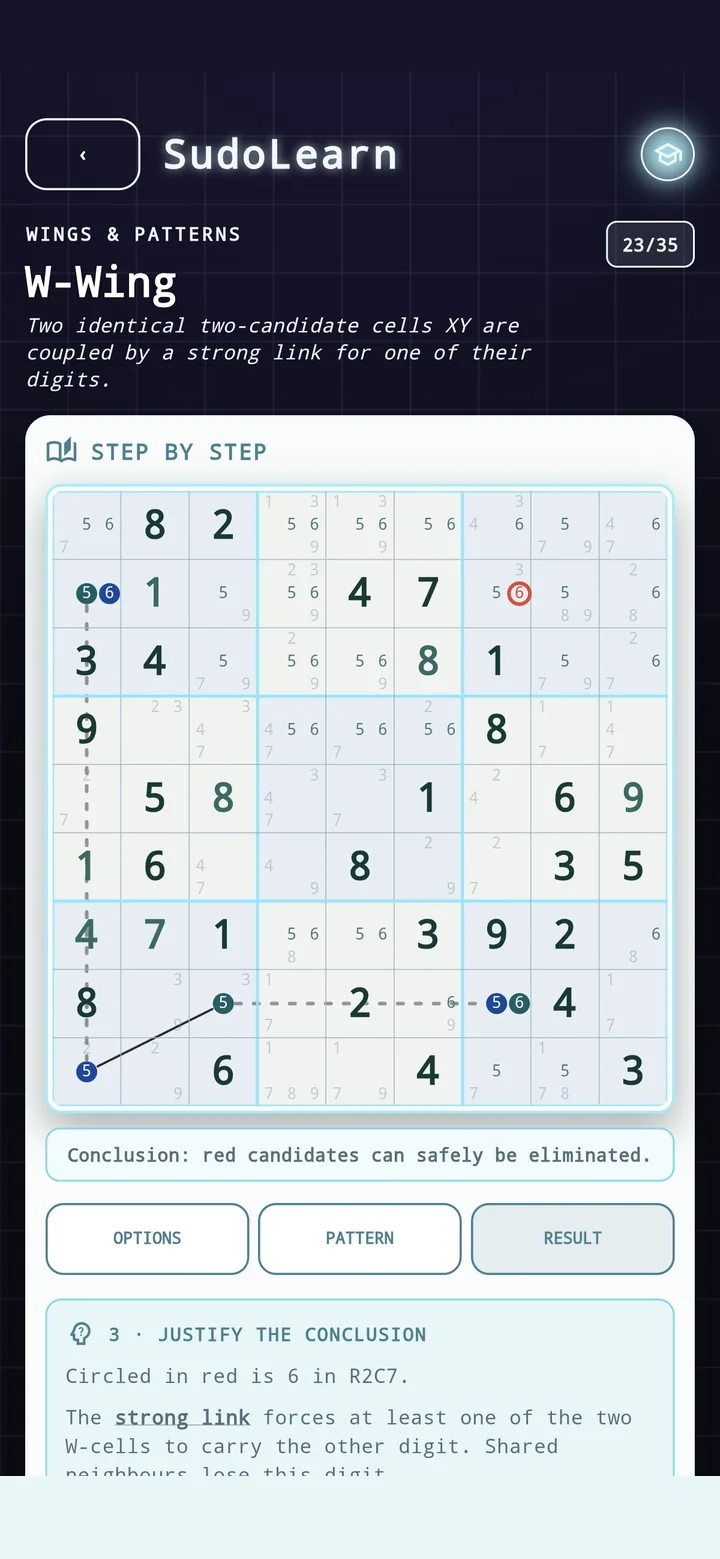
Two cells carry the same pair: row 2, column 2 with 5 and 8 and row 8, column 7 with 5 and 8 as well. The two do not see each other. As the bridge we take the 5: in row 5 it is only possible in column 2 and column 7 — the ends of the strong link.
One end sees the first pair cell along column 2, the other sees the second along column 7. If the 5 sits in row 5 column 2, row 2 column 2 loses its 5 and becomes an 8; if it sits in row 5 column 7, row 8 column 7 becomes an 8. So one of the pair cells is certainly an 8.
Both pair cells are seen only by row 2 column 7 and row 8 column 2 — each one along the row and the other along the column. That is where the 8 is eliminated. The 5 stays where it is.
Where it shows up in SudoSuite
The W-Wing is built in from Extreme upwards, together with the other wings, and stays with you through Ultra and Titan. The list of levels is on hard Sudoku.
- SudoLearn gives you the chapter on strong and weak links first and the one on the W-Wing straight after. In that order it stops being a hurdle and becomes the next logical step.
- SudoTrainer tests the W-Wing on purpose, without naming it if you prefer, and checks your reasoning, not just the answer. Another valid route counts just as much.
- SudoSelect (Pro) hands you a puzzle with the W-Wing guaranteed inside — as often as it takes until you see the bridge by yourself.
- Marks show the bridge in the grid: pair cells, link and target coloured separately. The thought lies in front of you instead of in your head.
Common mistakes
- Taking any link at all. The core mistake. The bridge has to be strong for X, that is, have exactly two possible places within one unit.
- Eliminating the wrong digit. You bridge over X and eliminate Y. Swap those and you delete the very candidates the pattern rests on.
- Similar pairs instead of identical ones. {5,8} and {5,9} are not a W-Wing.
- Only half-checking the target. The target cell has to see both pair cells. One is not enough.
W-Wing — two identical pairs and a bridge
Two cells with the same candidate pair, joined by a strong link. The W-Wing is where you find out whether you really understand links.
- The groundwork first. The Chains & links chapter sits ahead of every chain-like pattern in SudoLearn. Without strong and weak links the W-Wing stays a magic trick.
- Find the bridge yourself. In the lesson you pick the connecting line. Pick wrong and the app shows you why there is no strong link there.
- Repeat it in a game. SudoSelect guarantees the W-Wing as often as you like — the quickest way to make a rare pattern familiar.
Practise the W-Wing on purpose
SudoTrainer puts you in front of exactly this situation and checks your route, not just the answer. That is how a technique stays with you.
Common questions
What is a W-Wing in Sudoku?
Two cells with the same candidate pair, joined by a strong link for one of the two digits. At least one of the cells then takes the other digit, and every cell that sees both loses it.
What is a strong link?
A unit in which a digit has only two possible places left. At least one of those two places then carries the digit. Three places are not a strong link.
Do the two W-cells have to see each other?
No. The only cells that have to see each other are one end of the strong link and one of the two pair cells.
Which digit do you eliminate in a W-Wing?
The digit you do not bridge over. If the strong link runs over X, then Y drops out of every cell that sees both W-cells.
What is the difference between a W-Wing and an XY-Wing?
The XY-Wing needs a pivot that both wings see. The W-Wing needs none: there a strong link joins two identical pairs that may sit any distance apart.