Home › Hidden Rectangle
Hidden Rectangle in Sudoku — the rectangle you do not see
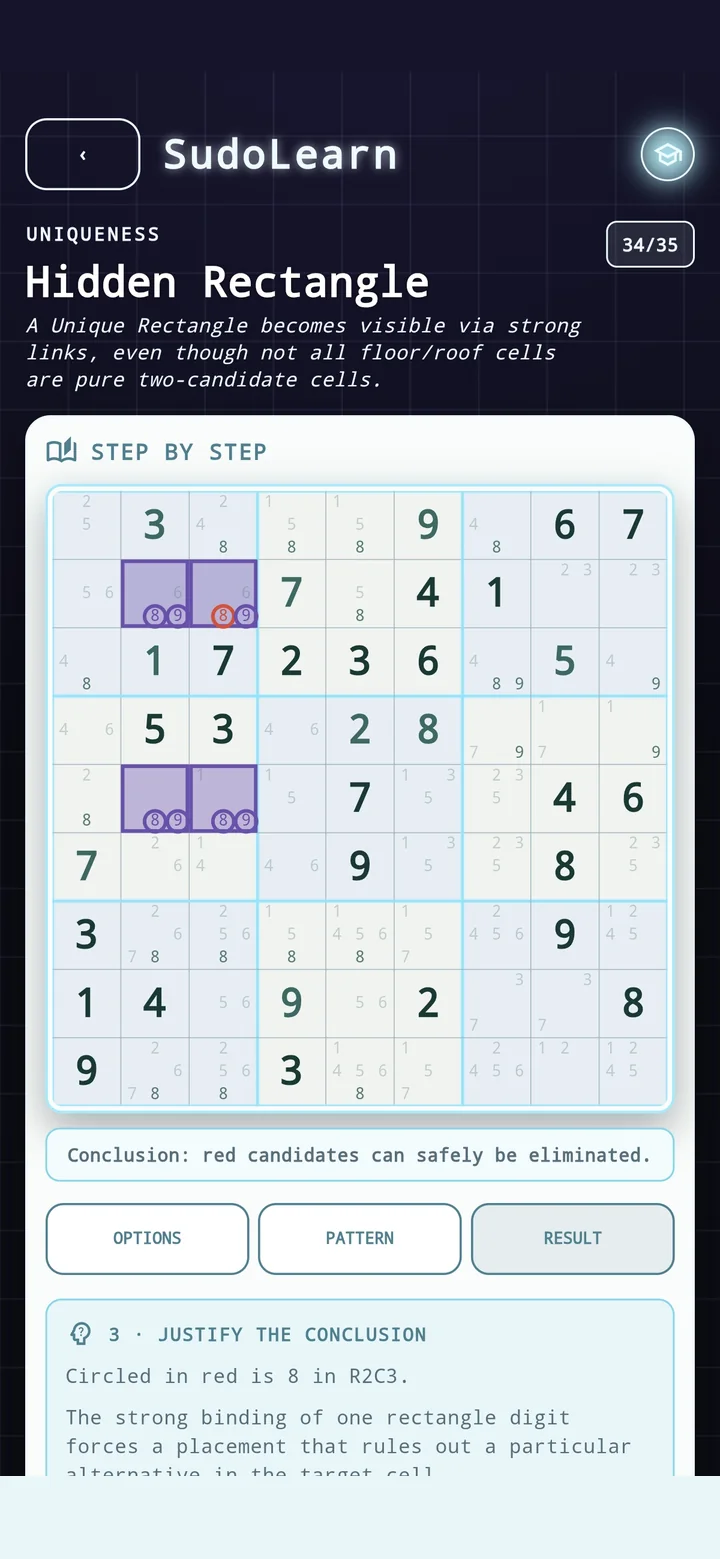
Here you eliminate a candidate because it would break your puzzle — Sudoku hardly gets more elegant. The Hidden Rectangle is the same deadly rectangle as in the Unique Rectangle, only the candidate pair does not sit openly in all four corners as a Naked Pair. Just one corner is a pure bivalue cell, the others carry extra candidates. The pattern only becomes visible through two strong links.
What is hidden here is not a digit but the rectangle itself. If you only look for three identical bivalue cells, you walk straight past this position — which is exactly what makes it such a lovely find once you have learnt to read it.
- Expert
- Never required
- Needs pencil marks
- Eliminates candidates
- Needs strong links
- Assumes one solution
How to spot one
- 1. Stake out the rectangle. Four unsolved cells in two rows, two columns and exactly two boxes. In all four corners both digits of the pair — a and b — have to be still possible.
- 2. Find the floor. One corner carries exactly a and b and nothing else. It is the anchor of the pattern.
- 3. Pick the target cell. That is the corner diagonally opposite the floor, not a neighbouring corner.
- 4. Check two strong links. Pick one of the digits, say b. In the row of the target cell, b must sit only in the two rectangle cells — and in its column likewise.
- 5. Eliminate. Then the other digit, a, falls away in the target cell.
Why it works
A strong link means that in this unit only two places are left for b, and one of them has to become b. Now assume the target cell were a. Then it is not b, and in its row only the neighbouring rectangle corner is left for b. The same goes for its column: there b has to go into the other neighbouring corner.
Both neighbouring corners would then be b. The floor sees both of them and can no longer be a b itself, so it becomes a. Now the rectangle holds a, b, b, a crosswise — and because both digits are allowed in all four corners, the swapped arrangement would be just as valid. A puzzle with one solution cannot have two: the target cell is not a.
A worked example
The corners sit in row 7 and row 8, column 4 and column 9. Column 4 belongs to the bottom centre box, column 9 to the bottom right box — two boxes, as required. The pair is 2 and 6, both digits are possible in all four corners, and no corner is a given.
The floor is row 7 column 4 with exactly 2 and 6; the target cell lies diagonally opposite in row 8 column 9. Now look at the 6: in row 8 it sits only in column 4 and column 9, and in column 9 only in row 7 and row 8 — two strong links on the 6.
If row 8 column 9 were a 2, the 6 of row 8 would have to go to column 4 and the 6 of column 9 to row 7. Then the floor loses its 6 and becomes a 2: the rectangle carries 2 and 6 crosswise and could be swapped. So the 2 is eliminated in row 8 column 9.
The assumption: exactly one solution
Like every uniqueness technique, the Hidden Rectangle needs an extra assumption: that the puzzle has only one solution. In SudoSuite that is guaranteed — every puzzle has exactly one solution and passes five checks. Here you are allowed to argue this way.
With a hand-drawn puzzle from an unknown source, nobody can promise you that. If it has two solutions, the technique eliminates a correct candidate for you. That is why Unique Rectangle, Hidden Rectangle and BUG+1 count as established but contested.
Where it shows up in SudoSuite
It is never necessary. No puzzle in SudoSuite demands a uniqueness technique; every one of them is checked to be solvable without it.
- SudoLearn walks you through the whole uniqueness family: Unique Rectangle type 1 and type 2 first, then the Hidden Rectangle, then BUG + 1. In that order a curiosity turns into a technique you actually use.
- Marks are your best tool here: strong links as solid lines, the four corners as a pattern. With that in the grid instead of in your head, you stop miscounting.
- SudoTrainer leaves the uniqueness techniques out at first — you switch them on the moment you fancy this family.
Common mistakes
- Only one strong link checked. You need both: in the row and in the column of the target cell. With one, nothing is proven.
- The wrong corner as target. You eliminate diagonally opposite the floor, not in a neighbouring corner.
- The wrong digit eliminated. The strong links hold for b, and a has to go. Mixing them up means eliminating the candidate that carries the pattern.
- Confusing it with the Hidden Pair. What is hidden here is the rectangle, not a pair. The Hidden Pair is a different technique, from the family of subsets.
- A given in one corner. Fixed digits cannot be swapped and play no part in the deadly rectangle.
Hidden Rectangle — the same argument, better hidden
As with the Unique Rectangle, this is about a rectangle that must not allow a second solution. Here the candidates simply aren't lying in the open.
- After the Unique Rectangle. SudoLearn deliberately puts this chapter later — it assumes the basic argument has settled.
- Follow it on the grid. The lesson marks the strong link everything turns on. In plain text you would read straight past it.
- Optional, never required. No puzzle demands this technique, which is why SudoSelect doesn't list it. It is a shortcut for whoever spots it.
Make strong links visible
With Marks you draw the links into the grid instead of juggling them in your head — and all of a sudden the hidden rectangle reads itself.
Common questions
What is a Hidden Rectangle in Sudoku?
A Unique Rectangle in which only one corner shows a naked candidate pair. The other corners carry extra candidates. Two strong links on one of the two rectangle digits let you eliminate the other digit in the diagonally opposite corner.
What is the difference from the Unique Rectangle?
In a Unique Rectangle three corners carry exactly the candidate pair, and you eliminate in the fourth. In a Hidden Rectangle only one corner is a pure pair; in return two strong links have to be present.
What is a strong link?
A digit has only two possible places left in a row, a column or a box. If one of them drops out, the other has to hold. So at least one of the two is true.
Which digit is eliminated?
The digit for which no strong links were checked. If the links are on one of the rectangle digits, the other one falls away in the target cell.
May a corner be a given?
No. A fixed digit cannot be swapped between two solutions, so the uniqueness argument collapses. All four corners have to be unsolved cells.
Do I need the Hidden Rectangle in SudoSuite?
No. No puzzle in SudoSuite requires a uniqueness technique; every one is solvable without it too. In SudoTrainer these techniques are switched off by default.