Home › Naked Pair
Naked Pair in Sudoku — two cells, two candidates
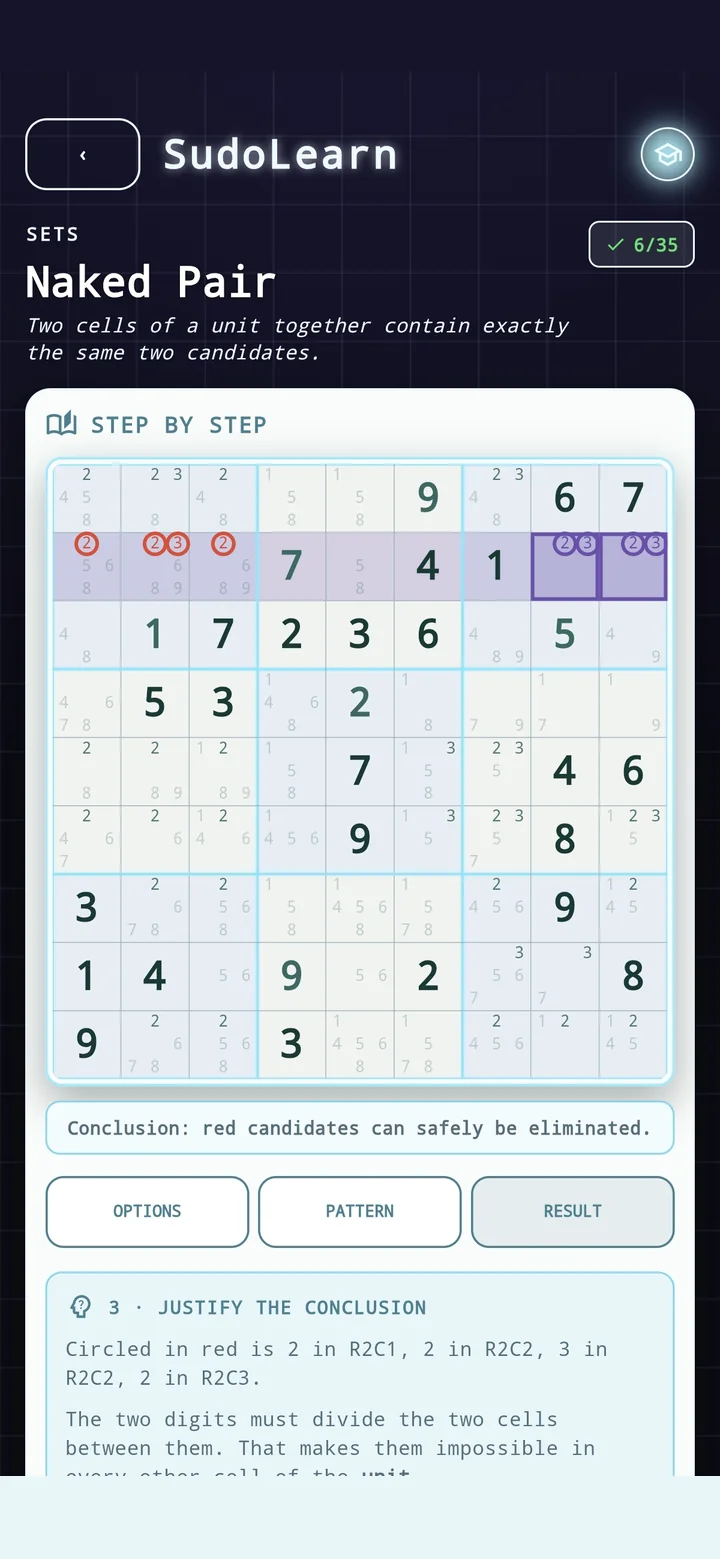
The first technique where you think of two cells together instead of one at a time — and you feel straight away how much that buys you. A Naked Pair is two cells of the same unit that together hold exactly the same two candidates, and nothing else. Those two digits have to divide the two cells between them. In every other cell of the unit they are therefore impossible, and you can eliminate them.
The pair places no digit, it tidies the pencil marks — and a Naked Single often drops out right afterwards, one you had not seen before. Naked, because it lies there in the open; the hidden counterpart is the Hidden Pair.
- Basic technique
- Needed from Extreme
- Needs pencil marks
- Eliminates candidates
- Also “naked twins”
How to spot one
- 1. Take one unit. You always search inside a single unit: a row, a column or a box. The richest hunting grounds are units with many cells that are down to two candidates.
- 2. Collect the bivalue cells. Note which cells of that unit have exactly two candidates left. Cells with three or more do not count.
- 3. Check for equality. Two of those cells form a Naked Pair if their candidate sets are identical — both {3,7}, for instance. One digit in common is not enough.
- 4. Eliminate in the rest of the unit. Remove both pair digits from every other cell of that unit. The two pair cells themselves stay untouched.
- 5. Do not forget the second unit. If the two cells also sit in the same box, the pair works there in exactly the same way and tidies up twice over.
Why it works
In a unit every digit may appear only once, and every cell has to end up carrying a digit. The first pair cell takes one of the two digits, the second takes the other — which goes where is still open, but both digits are used up inside those two cells. Nothing is left of them for any further cell of the unit. The elimination is therefore not a hunch, it is a proof. The one thing that matters is complete pencil marks in the pair cells: if one of them still hides a third candidate, the pair is no pair at all.
A worked example
We are working in row 4. The cell in row 4, column 1 is down to the candidates 3 and 7. The cell in row 4, column 6 is likewise down to 3 and 7. Both sets are the same, both cells lie in the same row — that is a Naked Pair.
If column 1 takes the 3, column 6 has to take the 7 — and the other way round. Either way the 3 and the 7 of row 4 are spoken for. So the 3 and the 7 are eliminated from every other cell of row 4. Row 4, column 3 held 3, 5 and 9 before — 5 and 9 remain. Row 4, column 8 held 2 and 7 — the 2 remains on its own, a Naked Single you can place straight away.
Where it shows up in SudoSuite
From Extreme upwards the Naked Pair and the Hidden Pair belong to the toolkit the level is built for; in Extreme a single step of that kind is often enough. In the higher levels too, the pair stays the workhorse between the big patterns. Which level asks for what is on hard Sudoku.
- SudoLearn has its own chapter on the Naked Pair — and you do not just read it, you apply the technique in the example grid straight away, with feedback on whether your reasoning holds.
- SudoTrainer puts the position in front of you without giving the name away. It checks your reasoning, not just the answer — and another valid route counts just as much.
- SudoSelect (Pro) hands you a puzzle with the pair guaranteed inside. You practise the technique instead of hunting for it.
Common mistakes
- A Naked Pair is not a Hidden Pair. In a Naked Pair two cells are down to those two digits; in a Hidden Pair two digits are down to those two cells — and there further candidates may well sit in the cells. This is by far the most common mix-up.
- One shared digit is not enough. {3,7} and {7,9} are not a pair. Both sets have to be the same, digit for digit.
- Eliminating outside the unit. You only eliminate in the unit the two cells share — not somewhere else in the grid.
- Incomplete pencil marks. A pair that only looks like a pair because a candidate went unwritten deletes candidates that had to stay.
- Overlooking the box. If both cells also sit in the same box, half the yield stays on the table when you only clear the row.
Naked Pair — the first move that really clears space
Two cells, two candidates, and the whole unit gets cleaner at a stroke. It is the technique that makes most players start keeping pencil marks.
- Hold it with marks. The Marks & colours chapter sits just before it and shows how to colour a pair instead of memorising it.
- Eliminate inside the lesson. You tap away the candidates that have to go. Remove one too many and the feedback catches you straight away.
- Or rule it out deliberately. With SudoSelect you can exclude Naked Pairs while you work on the fish family — no other Sudoku app lets you do that.
Practise pairs until they jump out at you
SudoLearn explains the technique, SudoTrainer tests it — no account, offline, as often as you like. One day the pairs come to you.
Common questions
What is a Naked Pair in Sudoku?
Two cells of one row, column or box that each hold exactly the same two candidates. Those two digits can be eliminated from every other cell of that unit.
Why is it called a Naked Pair?
Because the two candidates lie there in the open. Nothing else sits in the cells to cover them up, so you can read the pair straight off the pencil marks.
What is the difference between a Naked Pair and a Hidden Pair?
In a Naked Pair two cells are down to two candidates. In a Hidden Pair two digits are down to two possible cells — those cells may hold further candidates, and those are the ones you eliminate.
From which difficulty do pairs show up?
In SudoSuite they are built in from Extreme. In Ultra and Titan they stay part of the route, alongside the bigger patterns.