Home › Remote Pair
Remote Pair in Sudoku — spotting the distant pair
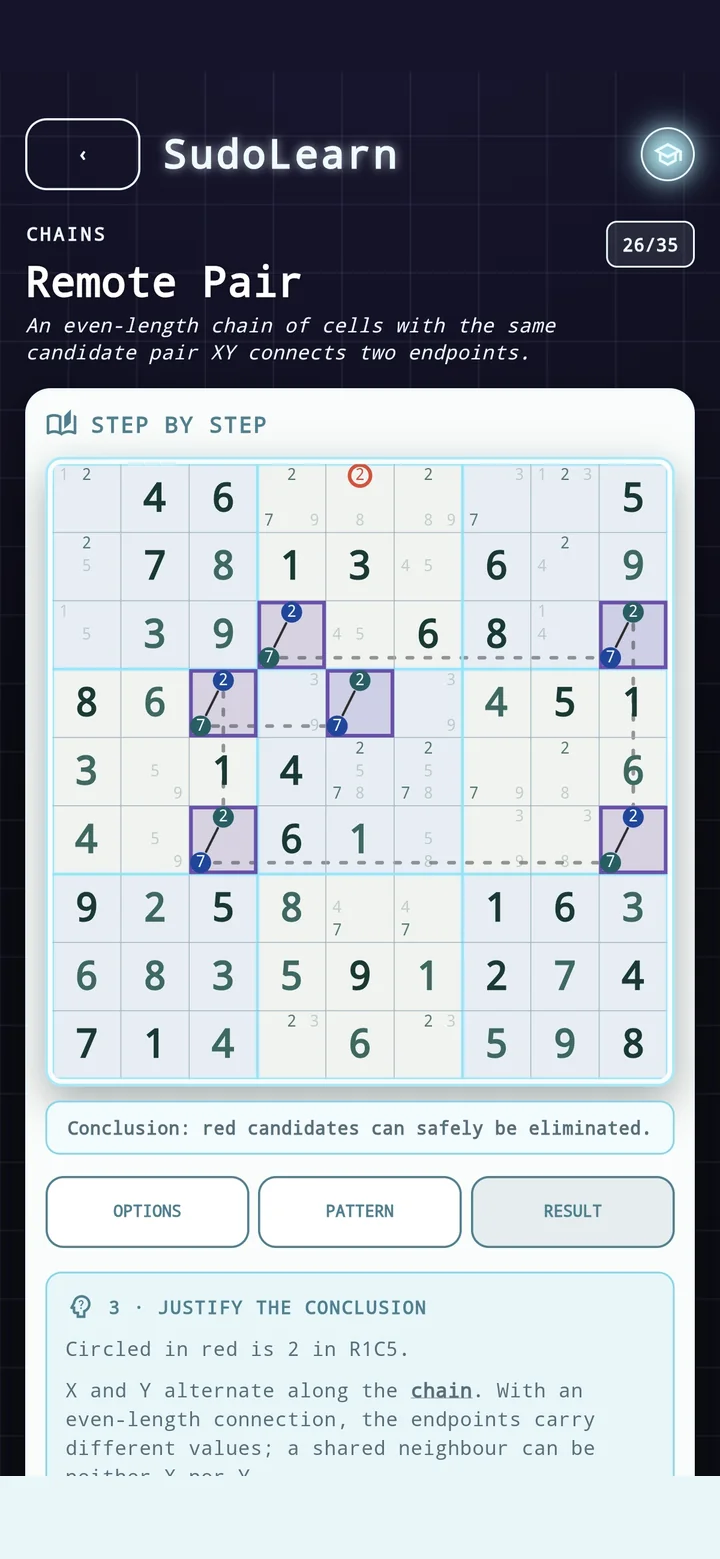
Your first real chain — and the friendliest one there is. A Remote Pair is a chain of cells that all carry the same candidate pair and see each other in sequence. Along the chain the two digits alternate. If the chain has an even length, the end carries the opposite digit to the start, and every cell that sees both ends loses both digits.
It is easier to find than a general chain because every node looks the same: always the same pair. In return it eliminates twice over — two candidates per target cell. Get the Remote Pair solid and you already have one foot in the chains.
- Advanced
- Needed from Titan
- Needs pencil marks
- Eliminates candidates
- Family: chains
How to spot one
- 1. Collect cells with exactly two candidates — and with exactly the same two. Four such cells are the usual minimum.
- 2. Build a chain. Every two consecutive cells have to see each other: same row, column or box.
- 3. Colour alternately. Two colours are enough for the whole chain.
- 4. Count the length. With an even number of cells, start and end have different colours. Only then does the elimination apply.
- 5. Eliminate. Every cell that sees both end cells loses both digits. Neighbours in the middle of the chain give you nothing new — there the Naked Pair has already done the tidying.
Why it works
Every cell of the chain carries one of the two digits; there is no third option. Neighbouring chain cells see each other, so they cannot carry the same digit. That is how the alternation travels along the chain.
With an even number of cells the opposite value therefore sits at the far end. Which distribution is the true one stays open — both digits are present at the ends either way, and a cell that sees both has room for neither. With an odd number of cells the ends carry the same digit, and you may only eliminate that one.
A worked example
Four cells are down to the pair 4 and 7: row 1 column 2, row 1 column 8, row 6 column 8 and row 6 column 3. The first two share row 1, the second and third column 8, the third and fourth row 6 — the chain is connected throughout.
If row 1 column 2 is a 4, then row 1 column 8 is a 7, row 6 column 8 is a 4 and row 6 column 3 is a 7. If it is a 7 there instead, the chain flips. Four cells is even, so the ends carry different digits.
Both ends see row 2 column 3 and row 3 column 3 — in column 3 like one end, in the top left box like the other — as well as row 4 column 2 and row 5 column 2 through column 2 and the left centre box. In all four cells 4 and 7 fall away: eight eliminations from one chain.
Where it shows up in SudoSuite
Every Titan puzzle contains at least one chain, and the Remote Pair is the friendliest of them. In Ultra it turns up now and then as a shortcut. More on hard Sudoku.
- SudoLearn opens the chain section with the Remote Pair, right after parity. That is the point where chains stop being intimidating.
- SudoTrainer tests the chain, on request without naming it. It checks your reasoning, not just the answer — and another valid route counts just as much.
- SudoSelect (Pro) hands you a puzzle with a guaranteed Remote Pair, whenever you want one.
- Marks are your best tool here: put the chain nodes in the grid and colour them alternately. That settles the most common mistake of all, miscounting the length. In SudoP you practise it with no clock at your back.
Common mistakes
- Not exactly the same pair. A cell with 4 and 8 instead of 4 and 7 breaks the chain.
- Miscounting the length. The classic mistake. With an odd number of cells the ends carry the same digit; eliminating both anyway destroys the puzzle. Count the cells, not the links.
- Letting three candidates in. For that there is the XY-Wing.
- Celebrating neighbours from the middle of the chain. Neighbouring chain cells form a Naked Pair and cleared their unit long ago. Only what sees both ends is new.
- Expecting a placement. The Remote Pair places nothing. Scan for singles again afterwards.
Remote Pair — a chain made entirely of pairs
Four or more cells with the same candidate pair, linked alternately. The pattern is easy to understand and surprisingly hard to spot.
- Work in colour. This is exactly what marks are for: colour the chain alternately and the elimination becomes visible instead of calculated.
- The lesson builds the chain with you. Cell by cell, and at every step SudoLearn checks whether the link holds.
- Needed from Titan. Remote pairs only come up in the hardest puzzles. With SudoSelect you can practise them before it gets serious.
Lay your first chain yourself
With SudoSelect you order exactly the chain you want to practise — and lay it into the grid with Marks instead of holding it in your head.
Common questions
What is a Remote Pair in Sudoku?
A chain of cells that all carry the same candidate pair and see each other in sequence. With an even number of cells, start and end carry different digits, and every cell that sees both ends loses both digits.
Why does the length of the chain matter?
Because the two digits alternate along the chain. With an even number of cells the ends are opposite, with an odd number they are the same. Only in the even case may you eliminate both.
Where do you eliminate in a Remote Pair?
In every cell that sees both end cells — through a row, a column or a box.
What is the difference from the XY-Wing?
In an XY-Wing three cells carry three different digits and only one is eliminated. In a Remote Pair every cell carries the same pair, the chain may be as long as you like, and both digits are eliminated.