Home › Locked Candidates
Locked Candidates in Sudoku — spotting Pointing and Claiming
This is the first proper technique — and the one that cracks your first puzzle that looked impossible. Locked Candidates uses the overlap of a box and a line: if every place for a digit in one unit is confined to the shared part, the digit drops out of the rest of the other unit. It comes in two directions — Pointing and Claiming.
It places no digit; it eliminates candidates. That is exactly where its value lies. After one or two Locked Candidates, several Hidden Singles often appear at once and the puzzle is running again. It is the moment where you stop looking at single cells and start weighing whole units against each other.
- Advanced
- Needed from Very hard
- Needs pencil marks
- Eliminates candidates
- Two variants
How to spot them
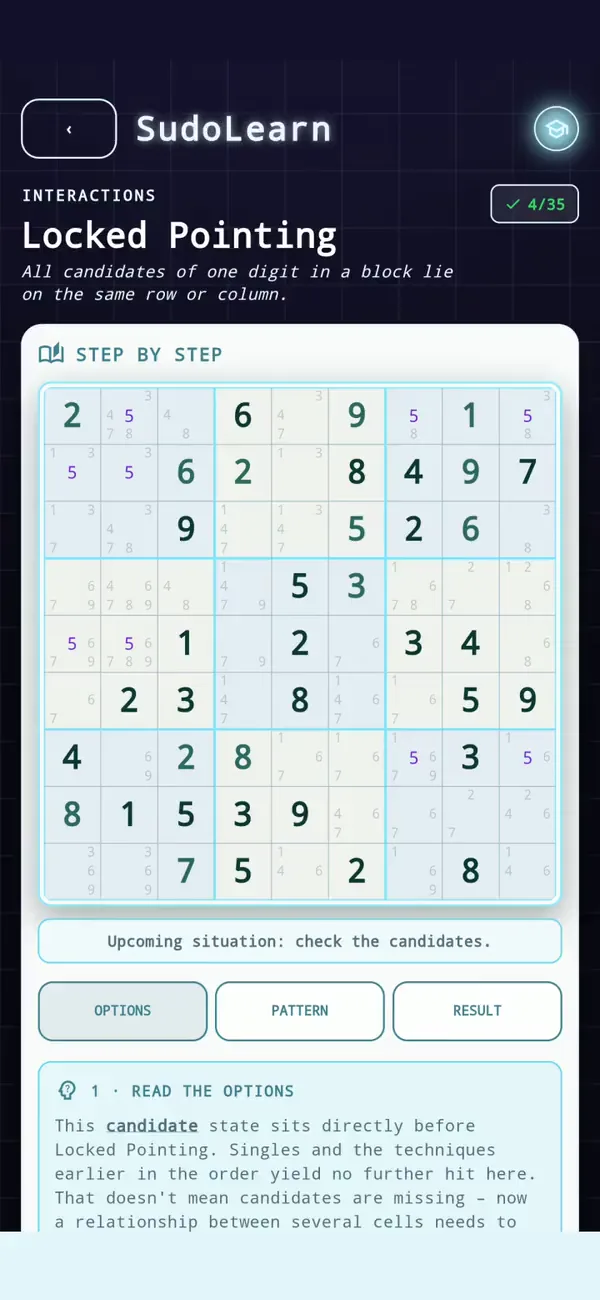
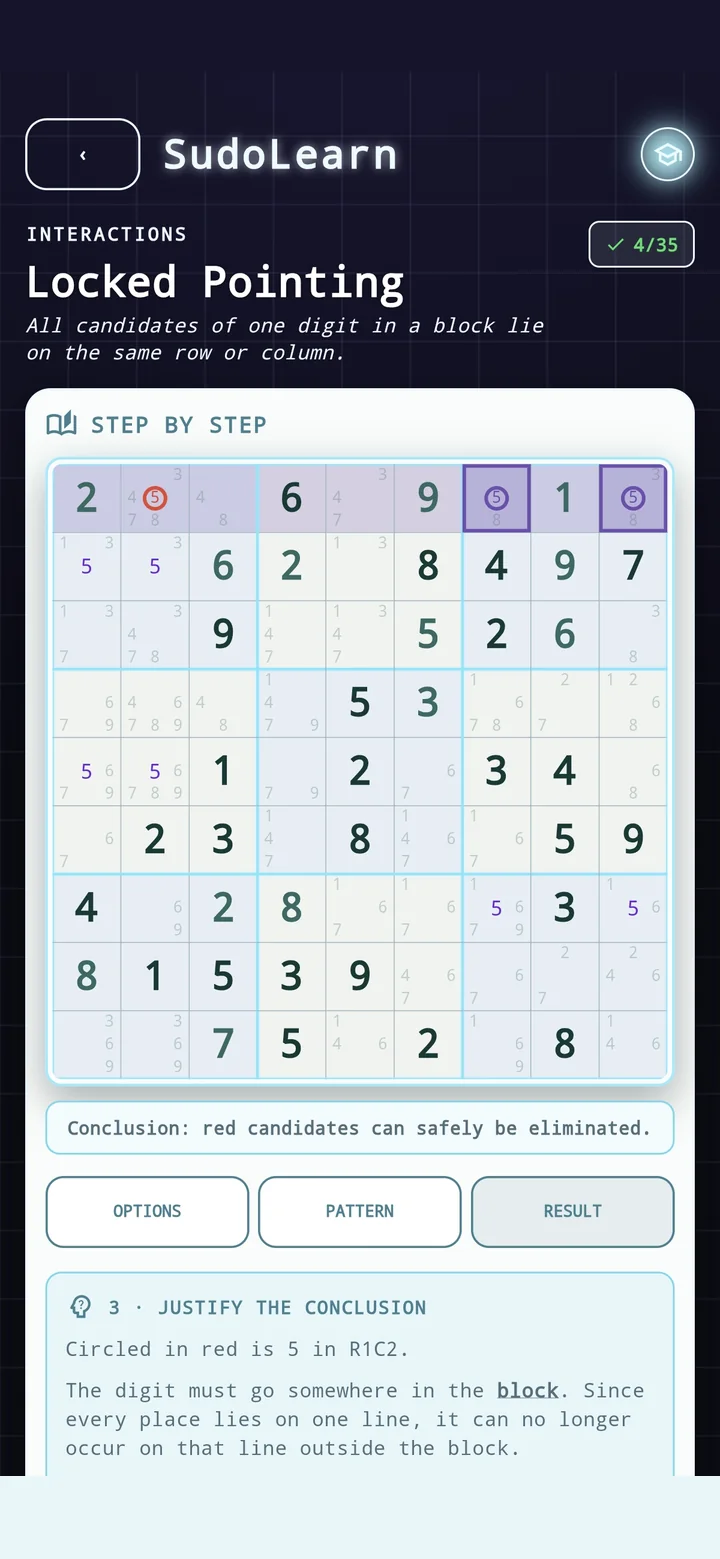
Pointing — the box points at the line:
- 1. Pick a box and a digit that is still missing from it.
- 2. Find every place for that digit inside the box. Boxes with only two or three candidates of the digit are the most productive.
- 3. If all those places lie in the same row or the same column, eliminate the digit on that line outside the box.
Claiming — the line claims the box:
- 1. Pick a row or a column and a digit that is still missing from it.
- 2. Find every place for that digit on the line.
- 3. If they all lie in the same box, eliminate the digit in that box outside the line.
Why it works
Both variants rest on the same rule: a digit occurs exactly once in every unit. With Pointing, the digit has to sit somewhere in the box — and because every possible place lies on one line, that line is certainly served from inside the box. Nothing is left over for the rest of the line. With Claiming it is the other way round: the digit has to sit on the line, every place lies in one box, so that box is served from the line — and in the rest of the box the digit is excluded. Either way, you eliminate where the other unit sticks out beyond the overlap.
A worked example
Pointing: in the middle box (rows 4 to 6, columns 4 to 6) the 3 can only go in two cells: row 4, column 4 and row 4, column 6. Both lie in row 4. So this box places its 3 in row 4 whatever happens — and therefore no 3 can remain in row 4 outside the box, that is in columns 1 to 3 and 7 to 9. Those candidates are eliminated.
Claiming: in column 7 the 8 can only go in row 1 and row 3. Both cells lie in the top right box. So this column places its 8 inside that box — and the 8 drops out of the box's other cells, that is columns 8 and 9 of rows 1 to 3.
Where they show up in SudoSuite
From Very hard upwards a named technique is normally needed, and Locked Candidates is the first of them. In the higher levels it is the tool that tidies up between the big techniques. The full list of levels is on hard Sudoku.
- SudoLearn gives Pointing and Claiming a chapter each — deliberately split, because here the direction you look in is the whole learning step. You practise on the grid, not on the text.
- SudoTrainer mixes both variants and never names them. It checks your reasoning, not just the answer, and lets another valid route count just as much.
- SudoSelect (Pro) hands you a puzzle with exactly this technique guaranteed inside — as many in a row as you need.
- Marks hold on to what you are thinking while you practise: candidates involved and eliminations in colour on the grid instead of in your head.
Easy to confuse
- Eliminating in the wrong direction. The classic error: with Pointing, eliminating candidates inside the box. Pointing works outward, Claiming works inward. Remember which unit supplies the statement — the other one loses the candidates.
- “All” really means all. If even one candidate of the digit sits in the box away from the line, the pattern is invalid. Incomplete pencil marks produce false eliminations here that you only notice much later.
- Confusing it with a Naked Pair. A Naked Pair is about two cells holding the same two digits. Locked Candidates is about one digit and its possible places.
- Expecting a placement. Locked Candidates places nothing. If you do not rescan for singles afterwards, you have thrown away half the work.
Telling pointing and claiming apart
Locked Candidates are two techniques under one name, and mixing them up means eliminating in the wrong unit. SudoLearn splits them into two chapters for exactly that reason.
- Two lessons, not one. Locked Pointing first, then Locked Claiming — both needed from Very hard upwards, each with its own worked grid.
- The SudoTrainer asks for the direction. It wants more than the elimination: it wants to know where you make it, in the box or on the line.
- Drill it on purpose. With SudoSelect you order a puzzle in which Locked Candidates are guaranteed. Twenty in a row, until the direction is automatic.
Keep Pointing and Claiming apart for good
SudoLearn explains both directions separately, SudoTrainer tests them mixed — after that you will not confuse them again.
Common questions
What are Locked Candidates in Sudoku?
Candidates of one digit that are locked inside a box or a line so tightly that they can only lie in the overlap of the box and the line. Outside the overlap the digit is eliminated.
What is the difference between Pointing and Claiming?
The direction you look in. With Pointing, every candidate in a box lies on one line and you eliminate on the line outside the box. With Claiming, every candidate on a line lies in one box and you eliminate in the box outside the line.
What is a Pointing Pair?
Pointing with exactly two candidates. With three candidates on the same line it is called a Pointing Triple; the conclusion is the same.
Do I need pencil marks for Locked Candidates?
Yes. The technique compares every place for a digit within a unit. Without complete candidate marks you cannot check whether they really all lie on the line.
Which technique comes after Locked Candidates?
Usually the X-Wing. It takes the same thought further, across two rows or two columns instead of a box and a line.