Home › XYZ-Wing
XYZ-Wing in Sudoku — how to spot it
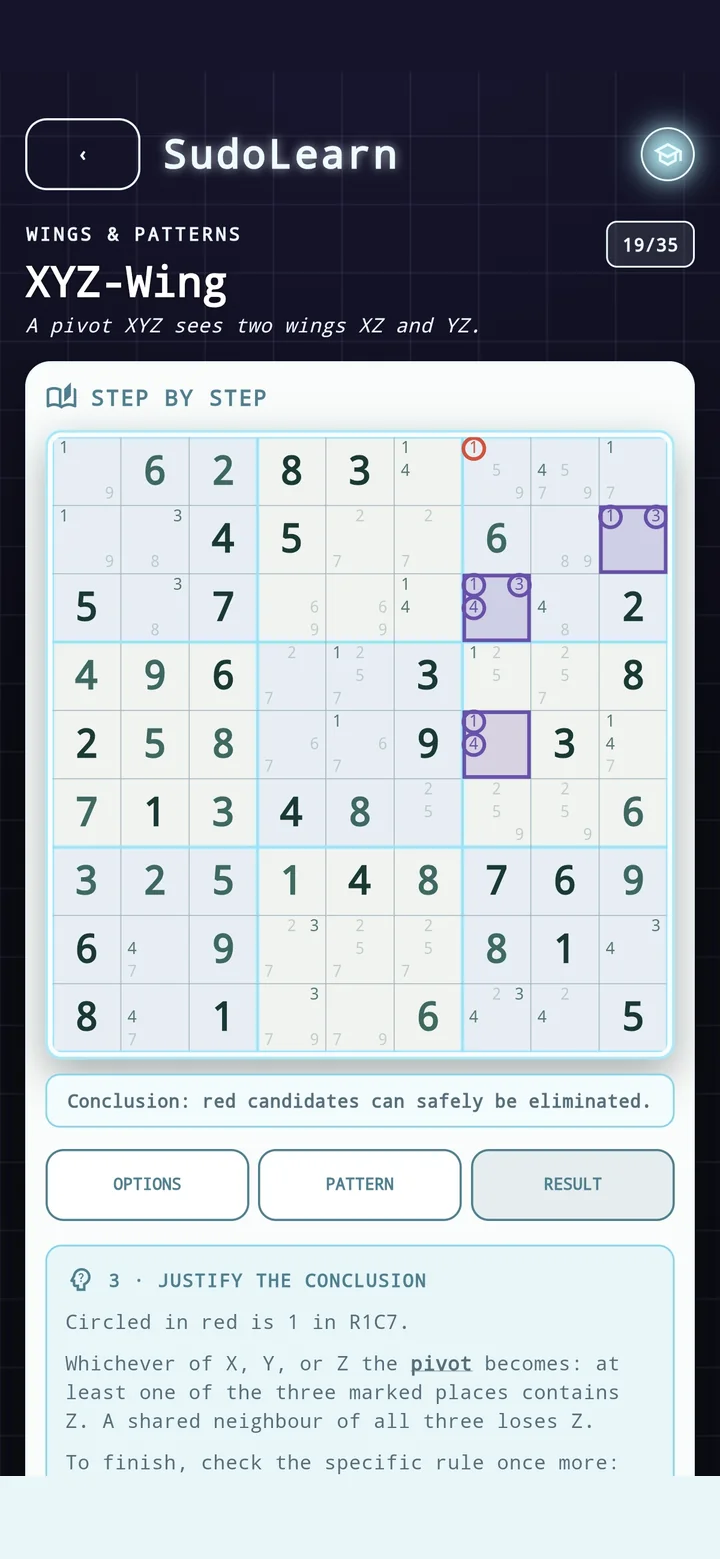
The XYZ-Wing works exactly where the clean XY-Wing fails — and it costs you one more thought, no more. It is the XY-Wing with one extra candidate in the pivot: the pivot cell carries X, Y and Z, the wings carry XZ and YZ. Whichever value the pivot takes makes no difference — one of the three cells becomes Z. Every cell that sees all three therefore loses the digit Z.
The difference from the XY-Wing is small and far-reaching: because the pivot itself can carry Z, the target has to see the pivot as well. That shrinks the elimination area — often a single cell is left. And sometimes that one cell is the one everything turns on.
- Advanced
- Needed from Extreme
- Needs pencil marks
- Eliminates candidates
- Wings family
How to spot one
- 1. Pick a three-candidate cell. The pivot has exactly three candidates — call them X, Y and Z.
- 2. Look for the first wing. A bivalue cell that sees the pivot and carries exactly X and Z.
- 3. Look for the second wing. A bivalue cell that also sees the pivot and carries Y and the same digit Z. The two wings do not have to see each other.
- 4. Determine Z. Z is the digit that occurs in all three cells. If there is no such digit, it is not an XYZ-Wing.
- 5. Find the target. Cells that see all three pattern cells. That is where Z drops out — usually they sit in the shared box.
Why it works
The pivot is X, Y or Z; there is no fourth option. If it is X, the wing holding XZ can no longer be X — it becomes Z. If it is Y, the wing holding YZ becomes Z for the same reason. If it is Z, it carries the digit itself. So in every case a Z sits in one of the three pattern cells.
A cell that sees all three pattern cells is therefore within sight of a placed Z, and cannot be a Z itself. If it sees only the wings, that is not enough: the case “the pivot is Z” would stand unrefuted. That is exactly where the XYZ-Wing differs from the XY-Wing, whose pivot can never be Z.
XY-Wing and XYZ-Wing compared
| XY-Wing | XYZ-Wing | |
|---|---|---|
| Candidates in the pivot | XY (two) | XYZ (three) |
| Possible Z carriers | the two wings | pivot and two wings |
| The target has to see | both wings | both wings and the pivot |
| Typical eliminations | one to several cells | usually exactly one cell |
A worked example
The pivot is in row 5, column 5 with 3, 4 and 7. The first wing sits in row 5, column 9 with 3 and 7 and sees the pivot along row 5. The second sits in row 6, column 4 with 4 and 7 and sees it through the middle box. The shared digit is the 7.
If the pivot is a 3, row 5 column 9 has to take the 7. If it is a 4, row 6 column 4 has to take the 7. If it is a 7, the digit sits in the pivot. So a 7 certainly sits in one of those three cells. All three are seen only by row 5 column 4 and row 5 column 6: along row 5 they see the pivot and the first wing, through the middle box the second. That is where the 7 is eliminated. Row 5 column 1 does not see the second wing and stays untouched.
Where it shows up in SudoSuite
The XYZ-Wing is built in from Extreme upwards, on the same level as the XY-Wing, and stays with you through Ultra and Titan. The list of levels is on hard Sudoku.
- SudoLearn puts it straight behind the XY-Wing — so you learn it at the moment the difference is obvious. With an example grid and an exercise inside the lesson.
- SudoTrainer tests it on purpose, without naming it if you prefer, and checks your reasoning, not just the answer. Another valid route counts just as much.
- SudoSelect (Pro) hands you a puzzle with the XYZ-Wing guaranteed inside — as often as it takes until you spot pivot and wings straight away.
- Marks keep pivot, wings and elimination apart by colour before you delete anything. With the narrow elimination area of the XYZ-Wing that is worth its weight in gold.
Common mistakes
- Forgetting the pivot when you eliminate. The mistake that defines this technique: anyone who only checks whether the target sees the wings eliminates candidates that have not been refuted.
- Confusing it with an XY-Wing. If the pivot has only two candidates, it is an XY-Wing — take that one, it eliminates more.
- Getting Z wrong. Z has to sit in all three cells. If the wings share a digit the pivot does not have, the pattern does not carry.
- Allowing wings with three candidates. The wings are bivalue cells. Only the pivot has three candidates.
XYZ-Wing — the pivot with one digit more
One extra candidate in the pivot, and suddenly the target cell has to see all three cells. That single difference from the XY-Wing is what costs most solvers the elimination.
- Learn it by comparison. SudoLearn puts XY- and XYZ-Wing back to back, so which cell has to see which one sticks.
- Quiz questions aimed at the trap. The questions between lessons go straight for that confusion. Get one wrong once and you never forget it.
- Your own puzzles for it. With SudoSelect the XYZ-Wing is guaranteed to appear — and a pre-solved start puts you right where it shows up.
Practise the XYZ-Wing on purpose
SudoTrainer puts you in front of exactly this situation and checks your route, not just the answer. A few rounds and the technique sticks.
Common questions
What is an XYZ-Wing in Sudoku?
A pivot cell with the three candidates XYZ and two bivalue cells XZ and YZ that see it. One of the three cells becomes Z, so every cell that sees all three loses the digit Z.
What is the difference between an XY-Wing and an XYZ-Wing?
The pivot. In an XY-Wing it has two candidates, in an XYZ-Wing three. That makes the pivot a possible Z carrier too, and the target has to see it as well.
Why does the target have to see the pivot in an XYZ-Wing?
Because the pivot itself can be Z. If the target does not see it, the elimination is not proven.
How many cells can an XYZ-Wing eliminate?
Usually exactly one, sometimes two. Because the target has to see all three pattern cells, the overlap of their lines of sight is small.
From which difficulty do you need the XYZ-Wing?
In SudoSuite from Extreme, that is on the same level as the XY-Wing. In Ultra and Titan it comes up regularly.