
Home › XY-Wing
XY-Wing in Sudoku — how to spot it
With the XY-Wing you stop hunting for patterns and start playing out cases — the step after which hard puzzles start to look solvable. An XY-Wing is made of three cells with exactly two candidates each: a pivot holding XY and two wings holding XZ and YZ. Whichever value the pivot takes, one of the two wings becomes Z. Every cell that sees both wings therefore loses the digit Z.
So you are no longer checking a pattern built from one digit, as with the X-Wing; you run two possibilities against each other and keep what holds in both. Once you see XY-Wings reliably, you are halfway to the chains.
- Advanced
- Needed from Extreme
- Needs pencil marks
- Eliminates candidates
- Also “Y-Wing”
How to spot one
- 1. Look for bivalue cells. The XY-Wing needs three cells with exactly two candidates each. No other cell can be part of the pattern.
- 2. Choose a pivot. Take a bivalue cell with the candidates X and Y — ideally one with many visible neighbours, so at the crossing of well-filled lines.
- 3. Find the wings. Look for two bivalue cells that see the pivot, that is, share a row, a column or a box with it. One carries X and a third digit Z, the other carries Y and the same digit Z.
- 4. Pick the target. Look for cells that see both wings. That is where the digit Z drops out.
Why it works
The pivot is either X or Y; there is no third option. If it is X, the XZ wing can no longer be X — it becomes Z. If it is Y, the YZ wing can no longer be Y — it becomes Z as well. So in either case at least one of the two wings carries the digit Z. A cell that sees both wings is therefore within sight of a placed Z whatever happens, and cannot be a Z itself. You never need to know which case actually applies.
A worked example
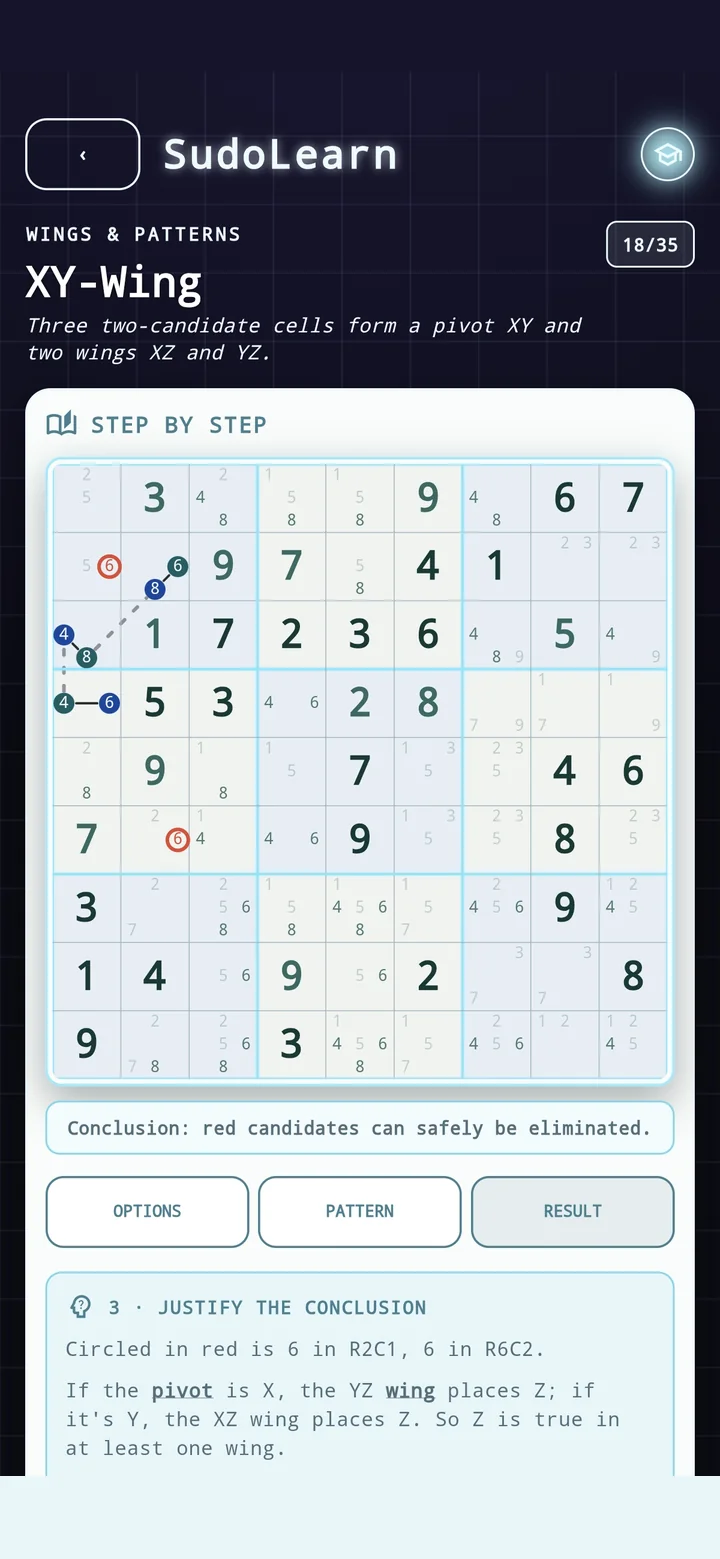
The pivot is in row 2, column 2 with the candidates 4 and 7. The first wing is in row 2, column 8 with 4 and 9 — it sees the pivot along row 2. The second wing is in row 6, column 2 with 7 and 9 — it sees the pivot along column 2. The shared third digit is the 9.
If the pivot is a 4, row 2 column 8 has to take the 9. If it is a 7, row 6 column 2 has to take the 9. So one of the two cells is certainly a 9. The cell in row 6, column 8 sees both wings — one along column 8, the other along row 6. The 9 is eliminated there. The two wings themselves do not have to see each other.
Where it shows up in SudoSuite
The XY-Wing is built in from Extreme upwards, where named techniques often appear in combination. In Ultra and Titan you meet it regularly as groundwork for the chains. The full list of levels is on hard Sudoku.
- SudoLearn has its own chapter on the XY-Wing, with an example grid and an exercise right inside the lesson. The XYZ-Wing and the W-Wing sit next to it — the whole family in one afternoon.
- SudoTrainer puts the position in front of you without giving the name away. It checks your reasoning, not just the answer, and lets another valid route count just as much.
- SudoSelect (Pro) hands you a puzzle with the XY-Wing guaranteed inside — as many in a row as you need.
- Marks show the two cases in the grid: true nodes, false nodes and the elimination in different colours. You see your argument instead of memorising it.
Easy to confuse
- The wrong target. The most common mistake: eliminating Z at the pivot, or in cells that see only one wing. You eliminate only where both wings reach — the target does not have to see the pivot.
- Taking cells with three candidates. All three cells involved must have exactly two candidates. If the pivot has three, it is not an XY-Wing but at best an XYZ-Wing — with a different conclusion.
- The wings do not have to see each other. Many people search in vain for a link between the wings. All that is needed is for each wing to see the pivot.
- Confusing it with the X-Wing. The X-Wing works with one digit across four cells, the XY-Wing with three digits across three cells. Y-Wing, on the other hand, is just a second name for the XY-Wing.
XY-Wing — three cells, and one of them decides
The XY-Wing is the first technique where you work with an assumption without guessing. Both cases land on the same conclusion, and that is something you have to walk through once yourself.
- The lesson plays out both cases. First one digit sits in the pivot, then the other. At the end SudoLearn shows why the target cell falls either way.
- The SudoTrainer wants the route. The target cell alone isn't enough — it asks which cell is the pivot and which are the pincers.
- Then repeat on purpose. SudoSelect guarantees XY-Wings in your next puzzle, or rules them out while you practise something else.
Practise thinking in cases
SudoLearn explains the XY-Wing, SudoTrainer checks your reasoning — and suddenly the way to the chains is short.
Common questions
What is an XY-Wing in Sudoku?
A pattern of three cells with two candidates each: a pivot holding XY and two wings holding XZ and YZ. In every cell that sees both wings, the digit Z is eliminated.
Is an XY-Wing the same as a Y-Wing?
Yes. Both names describe the same pattern. Y-Wing is the older name, XY-Wing describes the candidates more precisely.
Do the two wings have to see each other?
No. Each wing has to see the pivot. Whether the wings see one another makes no difference to the pattern.
Where do you eliminate in an XY-Wing?
In every cell that sees both wings. The digit Z cannot go there, no matter which value the pivot takes.
How is it different from an XYZ-Wing?
In an XYZ-Wing the pivot has three candidates instead of two. Because of that, the target must see the pivot as well, not only the two wings.
From which difficulty do you need the XY-Wing?
In SudoSuite from Extreme. That is where named techniques often appear in combination, and the XY-Wing is one of the most frequent.